Archive • 2000 — 2026

EverythingI’ve shipped.

Twenty-four engagements, in order. Each is shown as the site actually looked while I was working on it — pulled from the Wayback Machine where the original has since been redesigned, sold, or shut down. One is not a screenshot at all: it was built in Flash, and it plays here from the original 2009 file, in an emulator. It seemed more honest than a wall of logos.

24Engagements 25Years 11Recovered from archive 1Rescued from Flash
01

MEND Medical Wear

Founder, Architect & Developer · 2026 – Present

An ecommerce storefront for recovery apparel and connected care — washable hospital gowns, residential nurse scrubs, compression socks, and the AirGuard™ fall-detection collar.
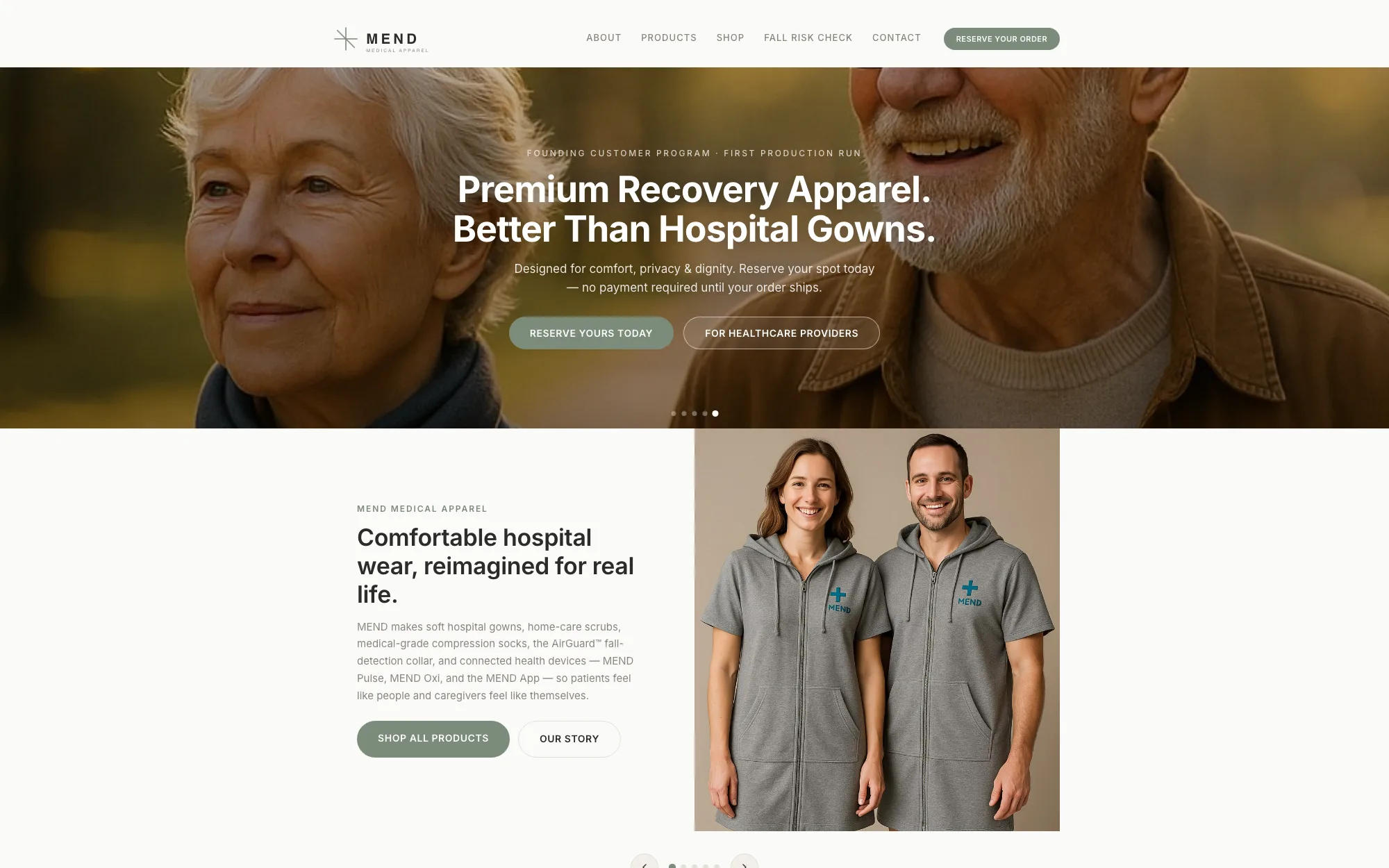
The MEND Medical Wear homepage: a smiling older couple photographed outdoors in warm light, overlaid with the headline “Premium Recovery Apparel. Better Than Hospital Gowns.” Below it, two people wear grey zip-front MEND gowns beside the heading “Comfortable hospital wear, reimagined for real life.”

The storefront as it stands. The hero deliberately photographs patients rather than products — the category’s convention is a flat-lay of fabric, which sells nothing to somebody about to spend a week in one. Everything below the fold is hand-written static HTML.

Live mendmedicalwear.com

Discovery

I started with the category rather than the product. Every competitor photographs folded fabric on white; nobody photographs the person wearing it, which sells nothing to somebody facing a week in hospital. That audit set three things: the positioning, the two buyer segments — patients and the people caring for them — and the decision to lead acquisition with a free fall-risk assessment instead of a discount code.

Architecture

Static-first, deliberately. Hand-written HTML, CSS, and JavaScript on Vercel, with no bundler and no framework for the storefront proper. A catalogue this size does not need a build step, and skipping one buys near-instant loads and a site that will still build in five years without a dependency archaeology dig. The one genuinely interactive tool runs on hand-written React shims so it could not drag a toolchain onto everything else.

Design

Brand identity, palette, and typography, then the photographic direction — patients and caregivers in real light rather than product flat-lays — and a product-page template that had to carry seven very different SKUs, from a cotton gown to a wearable sensor.

Development

Every line is mine: the storefront, seven product detail pages, and the React fall-risk assessment that scores against WHO fall data with charts and a regional model.

Integrations & APIs

The assessment posts to a serverless lead-capture endpoint. Alongside it, a full technical SEO program — www unification, clean product slugs, an image pipeline, security headers, sitemap and robots.

Delivered

  • Brand positioning, identity, and photographic direction from scratch
  • Seven product detail pages — gowns, scrubs, compression socks, the AirGuard™ collar, MEND Pulse, MEND Oxi, and the MEND app
  • React fall-risk assessment built on WHO fall data, wired to a serverless lead-capture endpoint
  • Technical SEO program and a static-first architecture with no framework lock-in
Role
Founder, Architect & Developer
Engagement
2026 – Present
Discipline
Development · Design · Ecommerce · Architecture
Static HTML/CSS/JSReactVercelTechnical SEOServerless
Visit site → React fall-risk tool →
02

Steven Hubbard LLC

Independent Consultant & Solutions Architect · Feb 2000 – Present

The consultancy’s own site — what the practice does, who it has done it for, and how an engagement runs.

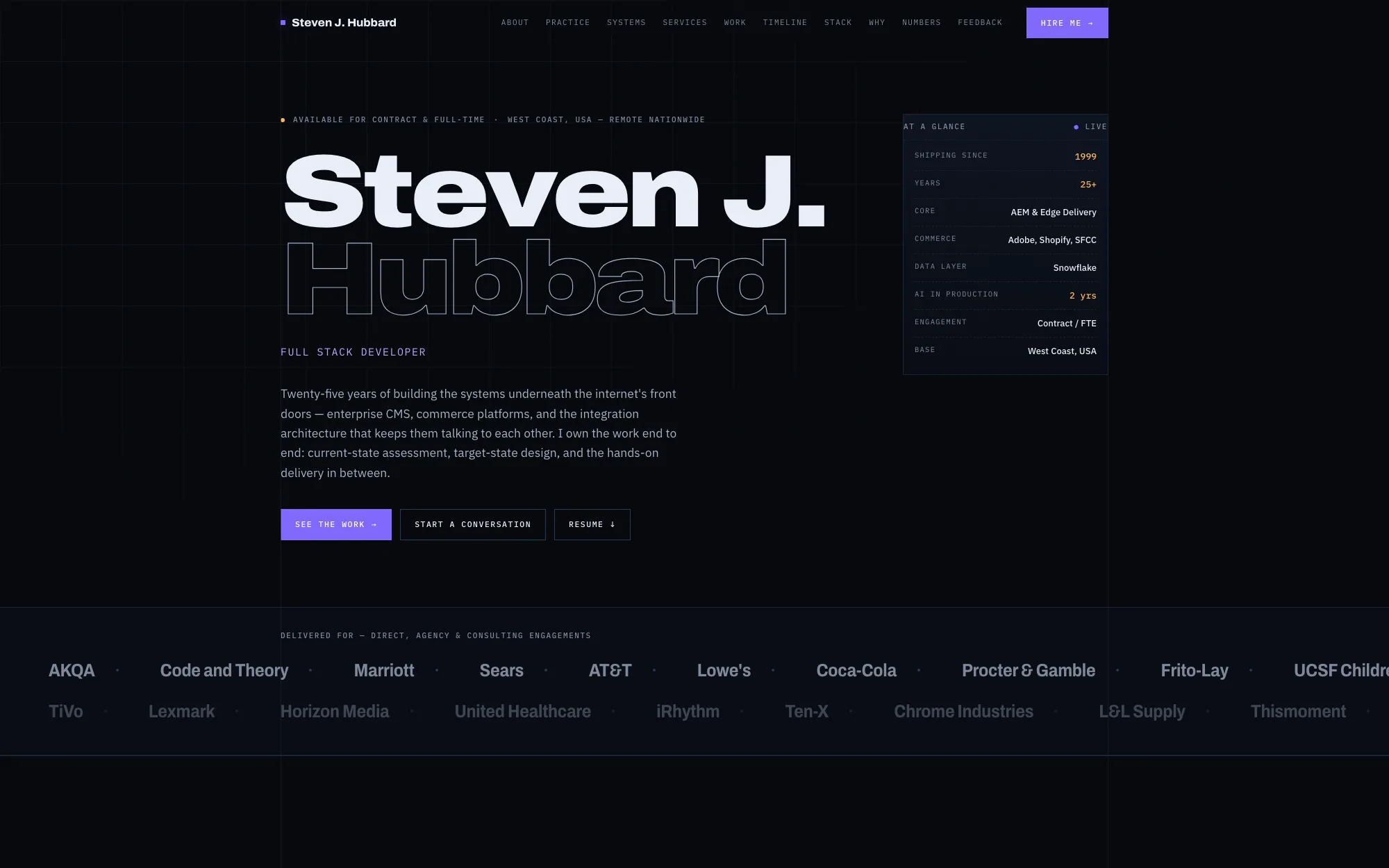
The stevenjhubbard.com homepage on a near-black background: the name “Steven J. Hubbard” set very large in outlined display type, an “at a glance” panel listing years, core platforms and availability, and a row of client names running along the bottom — AKQA, Code and Theory, Marriott, Sears, AT&T, Lowe’s, Coca-Cola.

The apex site, and the parent of this one. Same drafting-sheet identity, same accent that tracks the visitor’s local clock — the two domains are one design system, deployed twice.

Live stevenjhubbard.com

Discovery

Every engagement opens the same way: current-state assessment. What systems exist, which of them believe they are the source of truth, and where the seams are. Most organizations do not have a technology problem so much as four systems that each believe they own the customer. Finding that seam is the billable part; closing it is the easy part.

Architecture

Target-state design, data modeling, integration strategy, and feasibility review — documented as technical context diagrams and as-is/to-be architecture so business and technical stakeholders align before the build rather than during it.

Design

This site and its apex parent are one design system deployed twice: a drafting-sheet identity, a single type scale, and an accent colour that tracks the visitor’s local clock. Hand-written, no framework, same reasoning I bring to client work.

Development

I stay on the tools through delivery, which is the part that keeps the architecture honest — an architect who does not build ships diagrams that cannot be built. Handover includes solution architecture documentation, integration specifications, and reusable design patterns, so the client’s team can extend the work without me.

Integrations & APIs

Multi-system event-driven integration automating project intake and ticket routing across Workfront, Slack, and Salesforce over REST; ERP and commerce data consolidated into Snowflake as a governed executive reporting layer, replacing spreadsheet reconciliation.

Outcomes

  • Roughly 40% less triage handoff time from the Workfront–Slack–Salesforce integration
  • Spreadsheet reconciliation replaced by a governed Snowflake reporting layer
  • Architecture documentation and reusable patterns handed over for independent maintenance
Role
Independent Consultant & Solutions Architect
Engagement
Feb 2000 – Present
Discipline
Architecture · Integration · Development
WorkfrontSalesforceSnowflakeRESTEvent-driven
Visit site →
03

Eye Appeal Inc.

Senior Architect & Developer · Mar 2025 – Feb 2026

A collectible-grading platform for sports card collectors: an AI-scored reveal game, a proprietary grading metric, and a public registry.

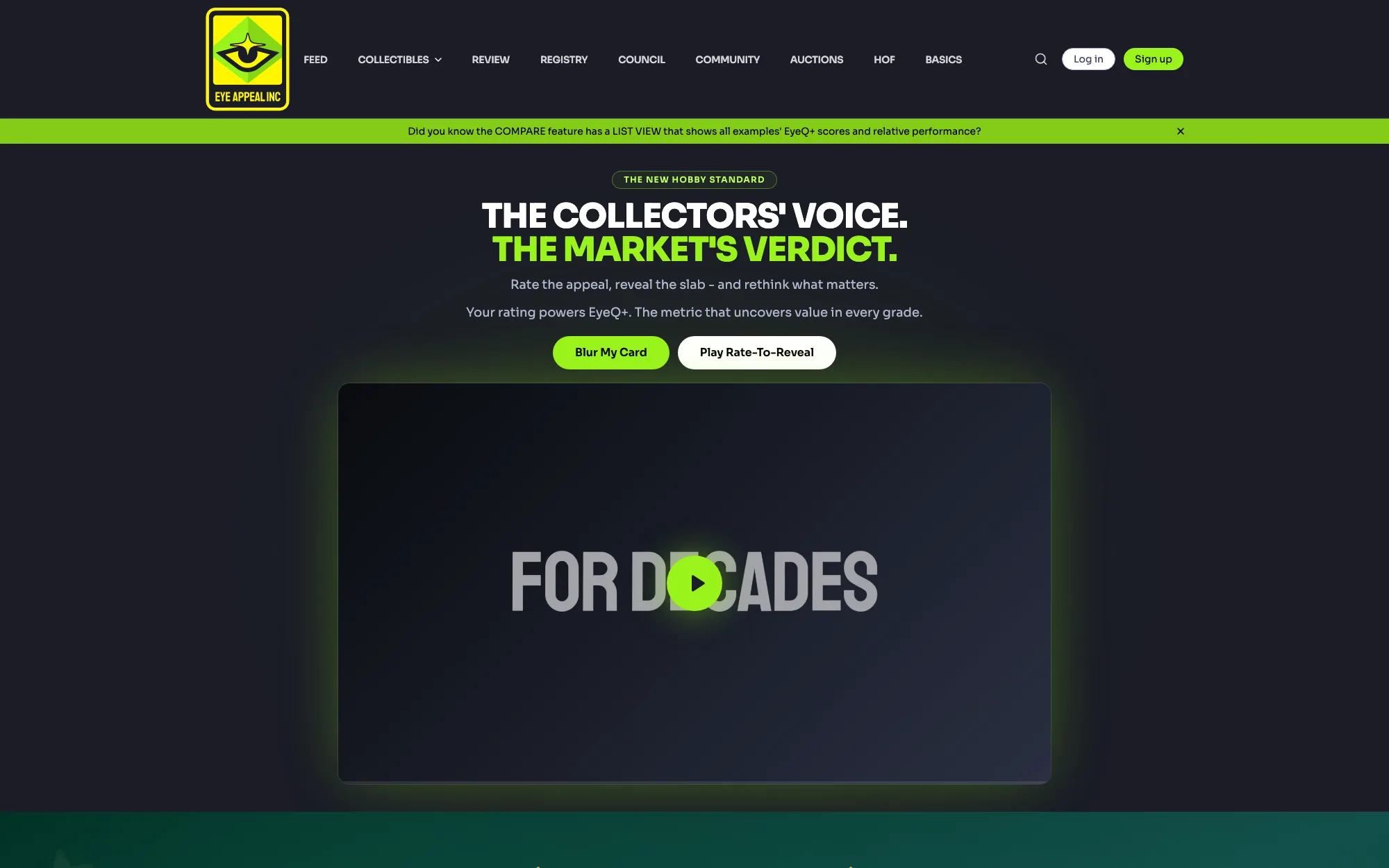
The Eye Appeal homepage in black and acid green: the headline “The collectors’ voice. The market’s verdict.” above buttons reading “Blur My Card” and “Play Rate-To-Reveal”, with a video panel below and a navigation bar carrying Feed, Collectibles, Review, Registry, Council, Community, Auctions.

The SvelteKit build, live. The two buttons in the hero are the whole product thesis — grading as a game you play rather than a report you receive — and the registry navigation behind them is what makes people trust the score.

Live eyeappealinc.com

Discovery

Three things had to work together, and each one undermined the others if built carelessly: an AI-powered Rate-to-Reveal game, the proprietary EyeQ+ scoring metric, and a global registry collectors would trust as a system of record. A grading platform lives or dies on whether people believe the number, so the discovery work was mostly about where that trust comes from and what would spend it.

Architecture

Cloud-hosted SvelteKit on Vercel. I architected the API integrations and workflow pipelines connecting internal systems to third-party platforms, each one designed as a reusable pattern rather than a one-off — that is the difference between the second integration taking days and taking weeks.

Design

The hero carries the entire product thesis in two buttons, Blur My Card and Play Rate-To-Reveal: grading as a game you play rather than a report you receive. The registry navigation sitting behind them does the credibility work.

Development

SvelteKit and TypeScript throughout, released to production weekly with zero downtime on two-week Agile iterations, with automated QA and data validation folded into the delivery pipeline rather than bolted on at the end.

Integrations & APIs

AI scoring services, third-party collectibles platforms, and the workflow pipelines carrying data between them and internal systems.

Outcomes

  • Lighthouse 95+ with sub-second load times in production
  • Zero-downtime weekly releases on two-week Agile iterations
  • 30% less manual development effort from automated QA and data validation in the pipeline
Role
Senior Architect & Developer
Engagement
Mar 2025 – Feb 2026
Discipline
Architecture · Development · Design · Integration
SvelteKitTypeScriptVercelCI/CDQA automationAI
Visit site →
04

Horizon Media

Web Director & Solutions Architect · Oct 2024 – Dec 2025

The corporate site and wider digital estate of the largest independent media agency in the US, plus the client platforms it runs.

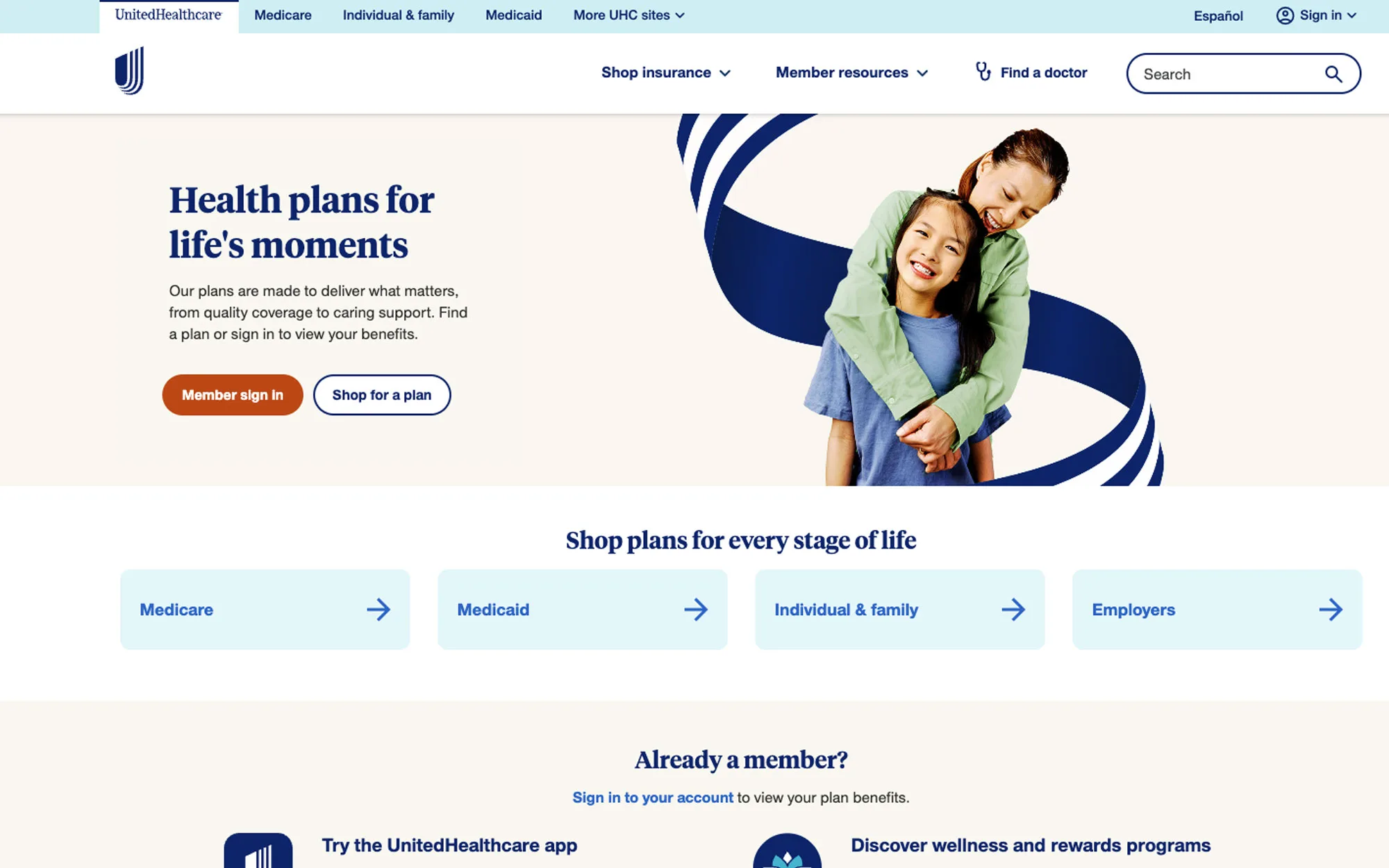
The UnitedHealthcare homepage: the headline “Health plans for life’s moments” beside a photograph of a smiling mother hugging her daughter inside a sweeping navy ribbon, with “Member sign in” and “Shop for a plan” buttons, above four tiles for Medicare, Medicaid, Individual & family and Employers.

UnitedHealthcare, one of the client properties audited for performance and accessibility — the half of the job that faced outward. Horizon’s own site is client-rendered and archives as an empty shell, so this image is my own.

Own archive Client property · UnitedHealthcare

Discovery

Two jobs running in parallel. Client-facing: performance, accessibility, and engagement audits across major brands including United Healthcare — healthcare is where accessibility stops being a checklist item and starts being the product. Internal: an inventory of the agency’s AEM and WordPress estate to find where properties had drifted apart and what that drift was costing.

Architecture

I served as the architecture authority across both ecosystems — governance standards, design patterns, component libraries, and the performance and security benchmarks every property was held to. Architecture options, risk assessments, and roadmap tradeoffs went to executive stakeholders to drive platform investment decisions. That work is invisible when it goes well, which is the point.

Development

WordPress systems refactored for speed and engagement, developer workflows and release process streamlined across teams, and AI-driven analytics wired into campaign reporting.

Integrations & APIs

The NetSuite–AEM ERP integration unified billing, content, and financial reporting data across on-premise and cloud systems. EDI and CRM integrations followed on the same backbone, and Snowflake became the governed data-warehouse reporting layer for cross-platform campaign and financial data. Both replaced processes that had previously run on spreadsheets and trust.

Outcomes

  • AI-driven analytics integration — campaign precision up 15%
  • WordPress systems refactored for 25% more speed and engagement
  • Developer workflows streamlined for 35% better efficiency
  • API-driven data pipelines cutting manual processes by 40%
Role
Web Director & Solutions Architect
Engagement
Oct 2024 – Dec 2025
Discipline
Architecture · CMS · Integration · Security
Adobe Experience ManagerNetSuiteSnowflakeWordPressAI analyticsGovernance
05

Coup D’Etat

Senior Architect & Developer · Contract · Jan 2019 – Mar 2025

The ecommerce site for a San Francisco luxury design showroom, where the photography is the catalogue.

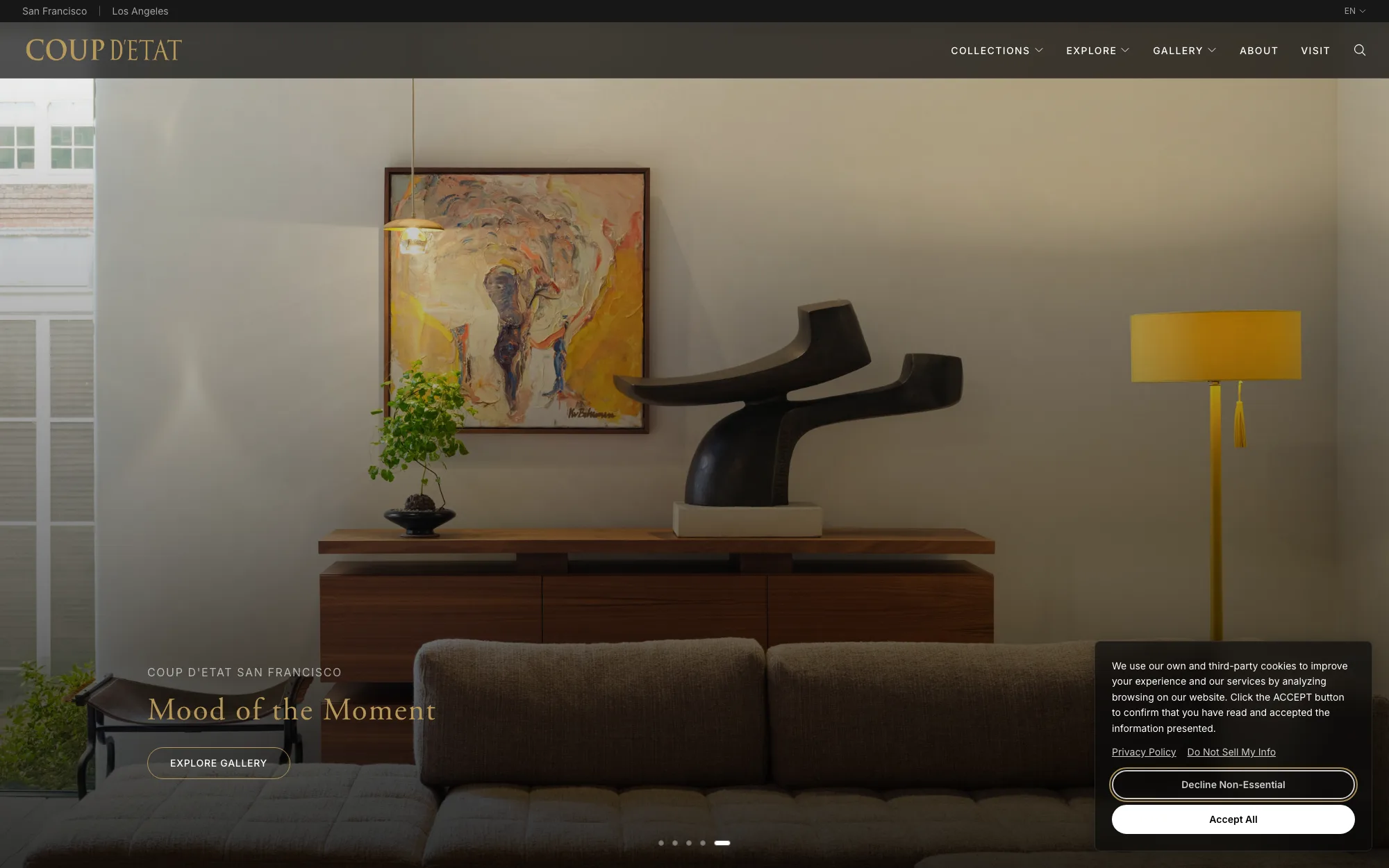
The Coup D’Etat homepage: a photographed interior in warm afternoon light — a sculptural black side table, a yellow floor lamp and an abstract painting above a walnut credenza — with the caption “Mood of the Moment” and an “Explore Gallery” button. A cookie consent panel sits over the lower right corner.

Six years of work, still live. A showroom catalogue where the photograph is the product, which is why the gallery experience was custom rather than a plugin. The consent panel is the archive being honest about 2020s web.

Live coupdetatsf.com

Discovery

I led platform discovery and requirements sessions with business and technical stakeholders, producing technical context diagrams and as-is/to-be architecture to align people before the build rather than during it. Six years in, the useful discovery stopped being “what should this feature do” and became “why do four of our properties solve this differently.”

Architecture

I established the architectural, security, and performance benchmarks that were then adopted across all client engagements, and diagnosed the WordPress platform issues underneath the recurring symptoms — downtime and load time were the visible part of a structural problem.

Design

A bespoke gallery experience built with the design and marketing stakeholders, for a catalogue where the photography is the product, plus product displays streamlined around what analytics said people actually did rather than what the room assumed.

Development

A custom WooCommerce module, a React interface layer, and the Storybook component library the whole team worked from — which also let stakeholders sign off components before production. Alongside the build I supported multiple concurrent Agile delivery teams through sprint planning, code review, and enforcement of the quality metrics, and ran multi-channel A/B testing across email and landing pages.

Outcomes

  • 40% increase in online sales efficiency from the custom WooCommerce module
  • 20% lift in completed CTAs from streamlined product displays
  • 35% better engagement and 20% lower bounce, guided by Google Analytics
  • 30% shorter deployment cycles from the Storybook library, plus 30% less downtime after the CMS remediation
Role
Senior Architect & Developer
Engagement
Jan 2019 – Mar 2025
Discipline
Design · Development · Ecommerce · Architecture
WooCommerceReactStorybookAgileGoogle Analytics
Visit site →
06

Lexmark

Front-End AEM Developer & Magento Architect · Oct 2022 – Mar 2023

Lexmark’s global site: AEM-managed content sitting in front of a Magento store selling printers and toner subscriptions.

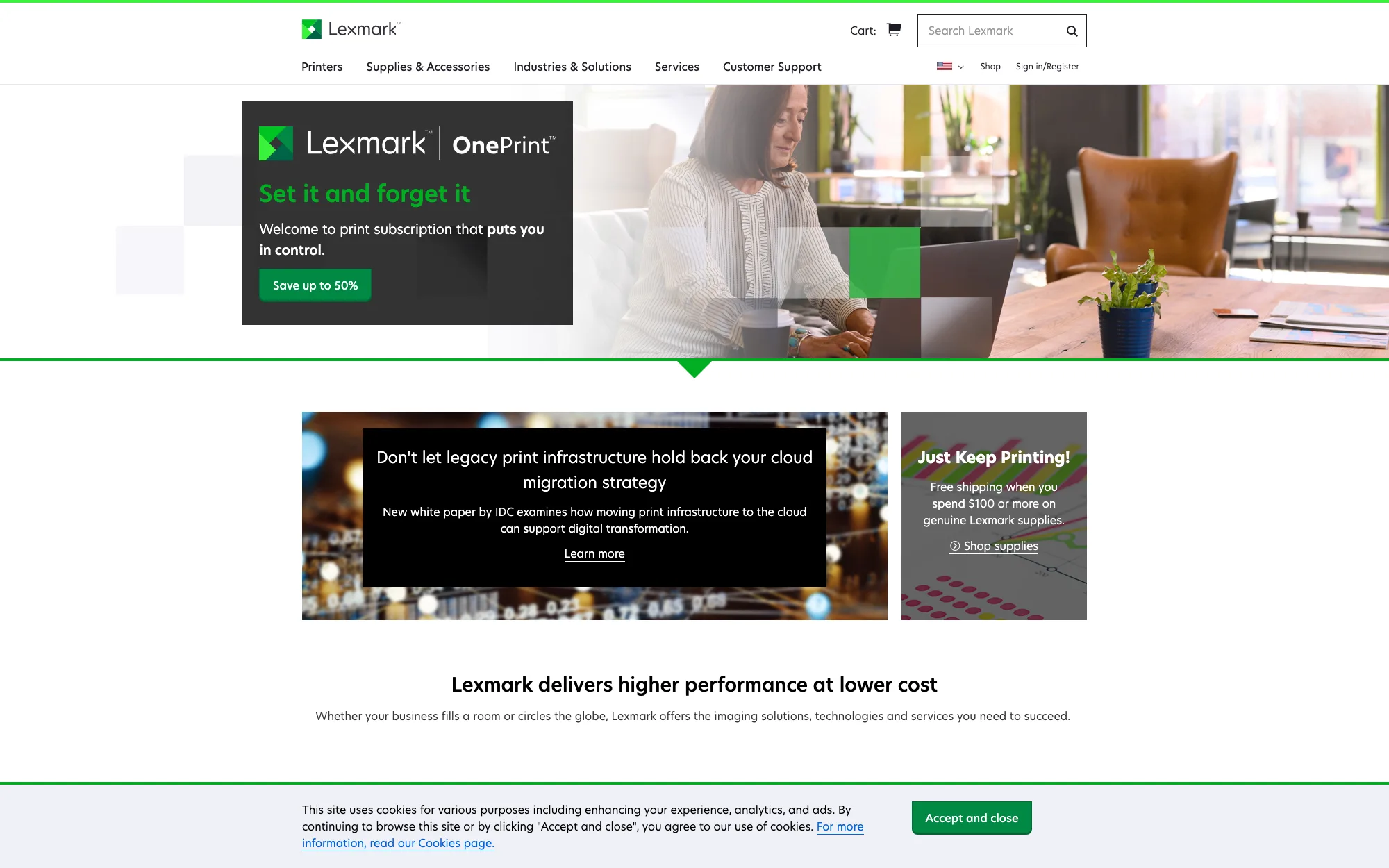
The Lexmark homepage in December 2022: a green-and-white layout with a “Lexmark OnePrint — Set it and forget it” panel over a photograph of someone working at a sunlit desk, promotional tiles for cloud print migration and supplies below, and the line “Lexmark delivers higher performance at lower cost.”

Captured inside the engagement window. The OnePrint subscription panel in the hero is the module I rebuilt to carry custom toner colour options — the configuration matrix behind that offer is where the actual complexity sat.

Archived Wayback · 2022

Discovery

Adobe Experience Manager and Magento are both entirely convinced they own the customer experience. The engagement opened by mapping which system should own what — content in AEM, inventory and cart in Magento — and where the seam between them would become visible to someone actually shopping.

Architecture

Custom plugins bridging the two platforms, so a single purchase journey crosses systems without the handoff showing. Designed so content editors kept working in AEM and merchandisers kept working in Magento, neither aware of the other.

Design

Custom AEM components built against the existing wireframes, and a rework of the subscription configuration UI — the toner-colour selector is the front door to the business model, and it had to make a large configuration matrix feel like a dropdown.

Development

I rebuilt the Magento 2.4 subscription module to offer custom toner colour options, which sounds small and was not: toner subscriptions are the business model, and the configuration matrix behind that dropdown is where the complexity lives. CMS components were refactored and performance-tuned for load time, and automated QA regression coverage went in behind the release.

Integrations & APIs

The AEM–Magento integration itself, plus REST calls inside React components fetching real-time printer information, with state management driving automatic content updates on the page.

Outcomes

  • 30% increase in user engagement and a 15% higher conversion rate from the AEM–Magento integration
  • 35% faster page loads from refactored CMS components, feeding a 20% gain in satisfaction scores
  • 20% higher satisfaction and 10% more subscription sales from the module rebuild
  • 20% less manual testing overhead from automated QA regression coverage
Role
Front-End AEM Developer & Magento Architect
Engagement
Oct 2022 – Mar 2023
Discipline
Architecture · CMS · Ecommerce · Development
Adobe Experience ManagerMagento 2.4ReactRESTQA automation
07

TiVo

Senior Ecommerce Architect · Dec 2020 – May 2022

TiVo’s direct-to-consumer store — hardware, accessories, and subscription service, sold alongside the marketing site.

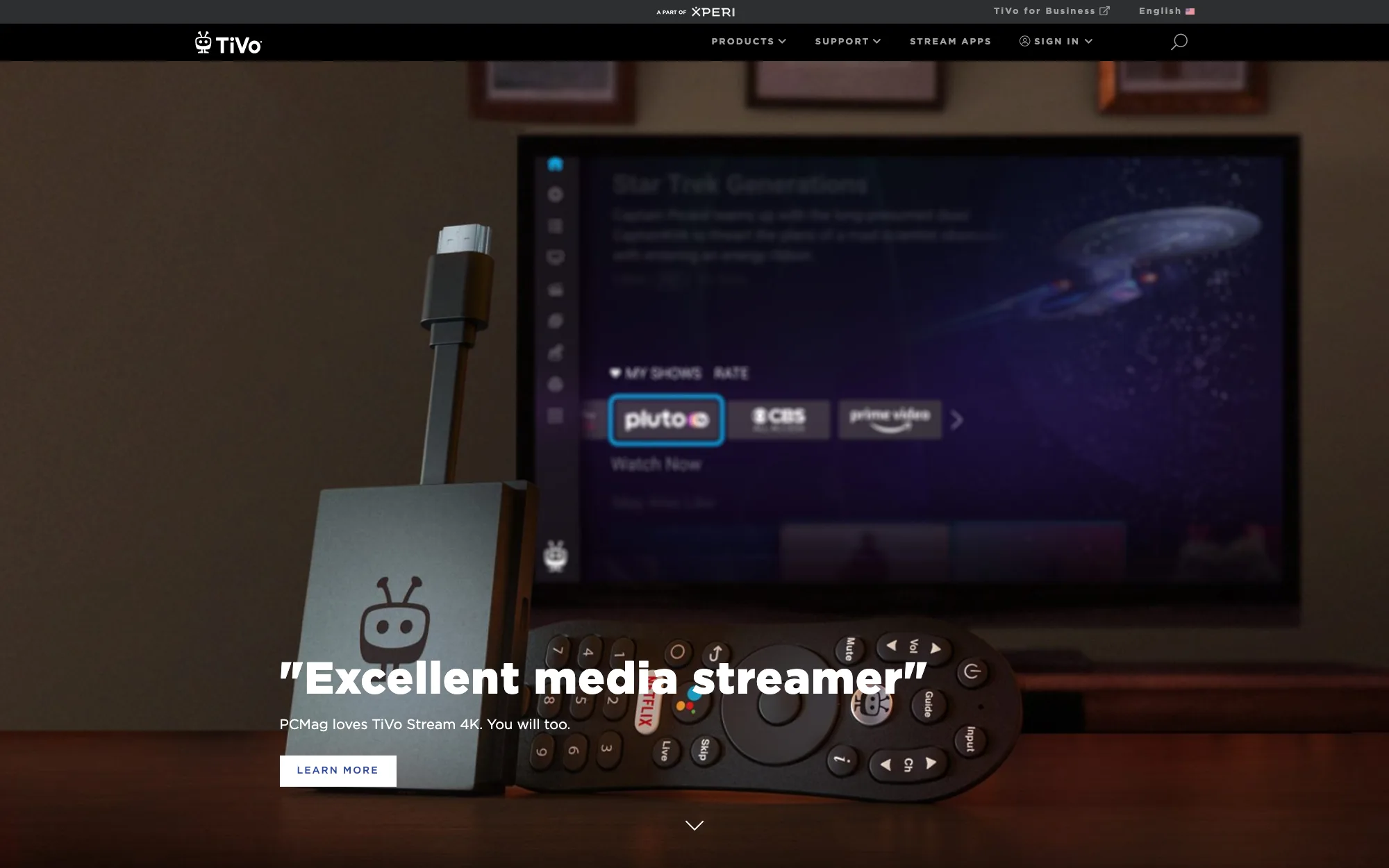
The TiVo homepage in November 2021: a dark product photograph of the TiVo Stream 4K dongle and remote in front of a wall-mounted television showing the TiVo interface, captioned “Excellent media streamer” with the line “PCMag loves TiVo Stream 4K. You will too.”

The Magento Enterprise 2.4 storefront, mid-engagement. What the page does not show is the reason it works: WebMethods and ERP integration keeping POS, order and product data agreeing with each other underneath.

Archived Wayback · 2021

Discovery

A legacy estate that had grown by accumulation: on-premise CMS platforms, several separate payment processors, and POS, order, and product data that did not agree with each other. The current-state assessment came before the migration plan, because the migration was never the actual problem.

Architecture

I designed and spearheaded the transition to Magento Enterprise 2.4, and the move of legacy on-premise CMS platforms onto cloud-hosted WordPress, Magento, and AEM — including stakeholder coordination and timeline management. That was the half the business could see. I also designed the workflow components that replaced several legacy systems outright.

Development

Java solutions against SQL Server, personalization and segmentation logic in Salesforce Commerce Cloud, and SQL Server performance tuning that cut query response times and improved reporting accuracy.

Integrations & APIs

The harder half. WebMethods and ERP integrations in Java and SOAP/XML unified POS, order, and product data across commerce and content systems, carrying EDI, CRM, and data-warehouse exchanges on the same backbone. POS and transaction data fed Snowflake to drive segmentation modelling in Salesforce Commerce Cloud — better targeting precision, less audience overlap between campaigns that had previously been competing for the same person. Marketo and Litmus were integrated with the AEM-driven properties, and the scattered legacy payment systems were consolidated onto a single Braintree integration.

Outcomes

  • Conversions up 18% and cart abandonment down 15% via AEM personalization and targeted campaigns
  • 30% less manual financial reconciliation from the WebMethods and ERP integration
  • Send-time optimization and A/B testing through Marketo and Litmus
  • Legacy payment systems consolidated onto a single Braintree integration
Role
Senior Ecommerce Architect
Engagement
Dec 2020 – May 2022
Discipline
Ecommerce · Architecture · Integration · CMS
Magento EE 2.4WebMethodsJavaSOAP/XMLSQL ServerSnowflakeMarketoBraintree
08

L&L Supply

Ecommerce Architect & Senior Developer · Feb 2020 – Mar 2021

A West Coast home and garden supplier’s storefront — a 10,000-product catalogue on Magento with a WordPress content site alongside it.

The L&L Supply homepage: the L&L Home & Garden Distributor logo above a Store, Vendors, Reps, Show and About Us menu, over a densely planted spring garden photograph headlined “The West Coast’s leading full line home & garden distributor”, with a blue band below reading “Providing the brands to grow your business”.

The storefront that received 10,000 products and 500,000 customer records off the legacy platform. The llsupply.com domain now belongs to an unrelated Antiguan distributor of the same name, so the archive is no help here — this image is my own.

Own archive Domain since reassigned

Discovery

What I inherited: a legacy ecommerce platform, a 10,000-product catalogue, half a million customer records, a tangle of separate payment processors, and a five-person team deploying without version control. I strategized the transition before touching any of it, because the sequence mattered more than the target platform.

Architecture

WordPress for content and Magento 2.3 for commerce, with custom store views for warehouse sourcing so the catalogue reflected where stock actually was rather than where the head office believed it was.

Design

Front-end and template work across both platforms as part of the migration, rather than a straight port of the legacy presentation.

Development

The migration itself: 10,000+ custom and simple products and 500,000 customer records carried across. A dropped row in that import is not a statistic, it is a long-standing customer who cannot log in and does not call to tell you — they just leave. I also put Git across every environment in a shop that had been deploying without it, and did the performance and security pass on the WordPress side.

Integrations & APIs

The legacy payment processors consolidated onto a single Braintree integration.

Team

The part I am most pleased with is the least technical. I mentored a five-person development team through PHP, WordPress, and component architecture, then wrote the standards down — code review criteria and documentation templates — so the improvement outlasted the engagement.

Outcomes

  • 20% improvement in site performance and reliability, and a lift in ecommerce conversion
  • 30% higher team productivity and code quality after mentoring
  • 40% faster onboarding for new developers from code review standards and documentation templates
Role
Ecommerce Architect & Senior Developer
Engagement
Feb 2020 – Mar 2021
Discipline
Ecommerce · Architecture · Design · Development
Magento 2.3WordPressPHPGitBraintreeData migration
09

iRhythm Technologies

Senior HubSpot Developer · Jan 2019 – Dec 2019

The marketing site for the Zio patch, a wearable cardiac monitor — landing pages, a physician locator, and the email program around them.

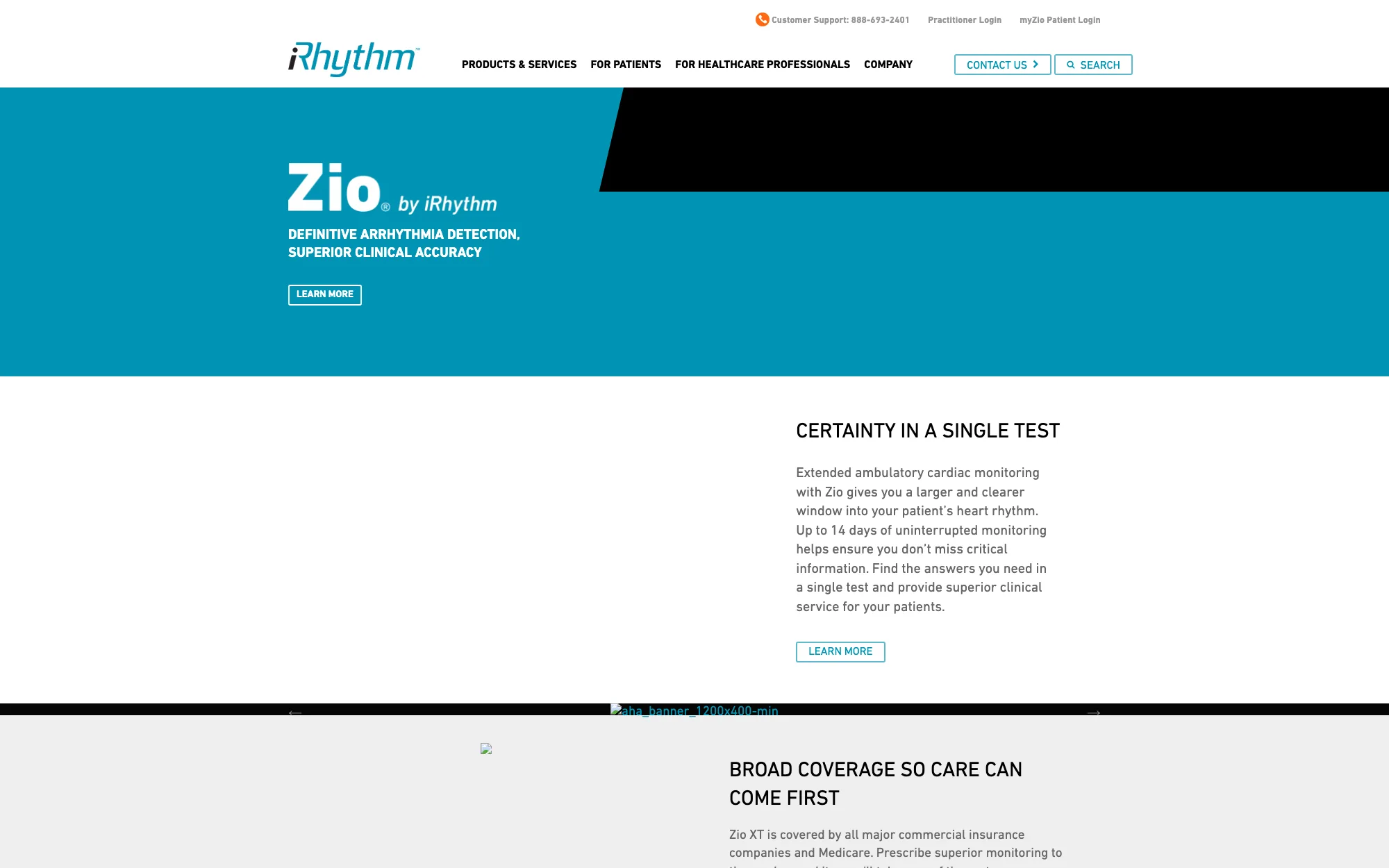
The iRhythm homepage in June 2019: a teal hero reading “Zio by iRhythm — definitive arrhythmia detection, superior clinical accuracy” with a Learn More button, above a section headed “Certainty in a single test” describing up to 14 days of uninterrupted cardiac monitoring.

The marketing site as it stood during the engagement. Two audiences share one page — For Patients and For Healthcare Professionals sit side by side in the navigation — which is why the physician locator had to serve a worried patient and a referring cardiologist at once.

Archived Wayback · 2019

Discovery

The site’s actual job is to move a worried person from “my doctor mentioned this” to a booked appointment. Framing it that way changed the priority order: the physician locator became the most important thing on the site, and the email program became the thing that closes the gap for everyone not ready on the first visit.

Development

Customized HubSpot landing pages and modules built for campaign reuse rather than one-offs, plus direct and marketing email templates written to survive the rendering quirks of every client a fifty-year-old patient might plausibly be reading in.

Integrations & APIs

I built the physician locator as an API-driven mapping application rather than a static list, so it stayed correct as the provider network changed — a static list of cardiologists is wrong within a quarter and nobody notices until a patient does.

Outcomes

  • 30% boost in lead conversions from the custom HubSpot landing pages and modules
  • 23% longer visit duration from the API-driven physician locator
  • 38% lift in opens and click-through from the redesigned email templates
Role
Senior HubSpot Developer
Engagement
Jan 2019 – Dec 2019
Discipline
Development · CMS · Integration
HubSpotRESTEmail templatesLanding pages
10

Ten-X

Senior WordPress Developer · Sep 2015 – Jan 2018

A commercial real estate marketplace that moved property auctions online.

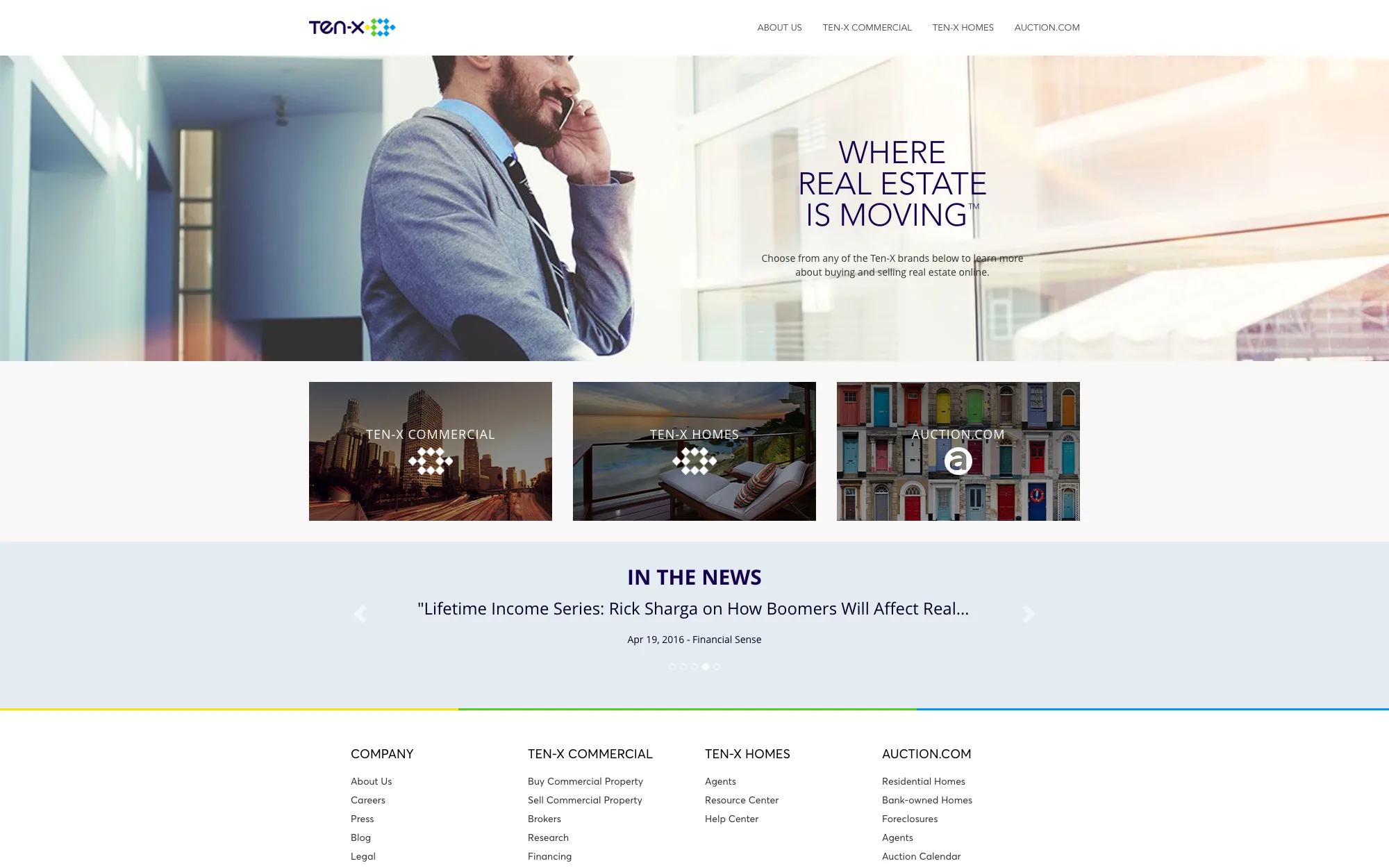
The Ten-X homepage in December 2016: a photograph of a man on a phone in a glass-walled office, headlined “Where real estate is moving”, above three tiles for Ten-X Commercial, Ten-X Homes and Auction.com, then an “In the News” strip and a four-column footer.

The WordPress platform I ran enhancements on. Three brands sharing one chassis is the constraint that shaped everything — including the auto-build deploy that replaced a manual release process.

Archived Wayback · 2016

Discovery

I led the team meetings driving WordPress platform enhancements — the roadmap came out of those sessions rather than off a ticket queue — and contributed to the technical specifications and architecture design that came out of them.

Design

Advised on site design and UX/UI enhancements across the marketplace, working with the design team rather than around them.

Development

Custom PHP-based WordPress themes and platform enhancements built against those specifications, aligned to business goals rather than to a feature list, plus the technical SEO program that turned out to be the highest-return work of the engagement.

Delivery

The deployment side mattered as much as the features. I deployed auto-build procedures to production with real testing and validation, replacing a release process that worked fine right up until the person who knew it took a holiday.

Outcomes

  • 35% increase in conversions from the SEO program
  • 25% more site traffic from platform enhancements
  • Automated build and deploy to production with rigorous testing and validation
Role
Senior WordPress Developer
Engagement
Sep 2015 – Jan 2018
Discipline
CMS · Development · Security · Architecture
WordPressSEOCI/CDAuto-build
11

Chrome Industries

Magento Developer · 2014 – 2015

The ecommerce site for a San Francisco cycling bag and apparel brand.

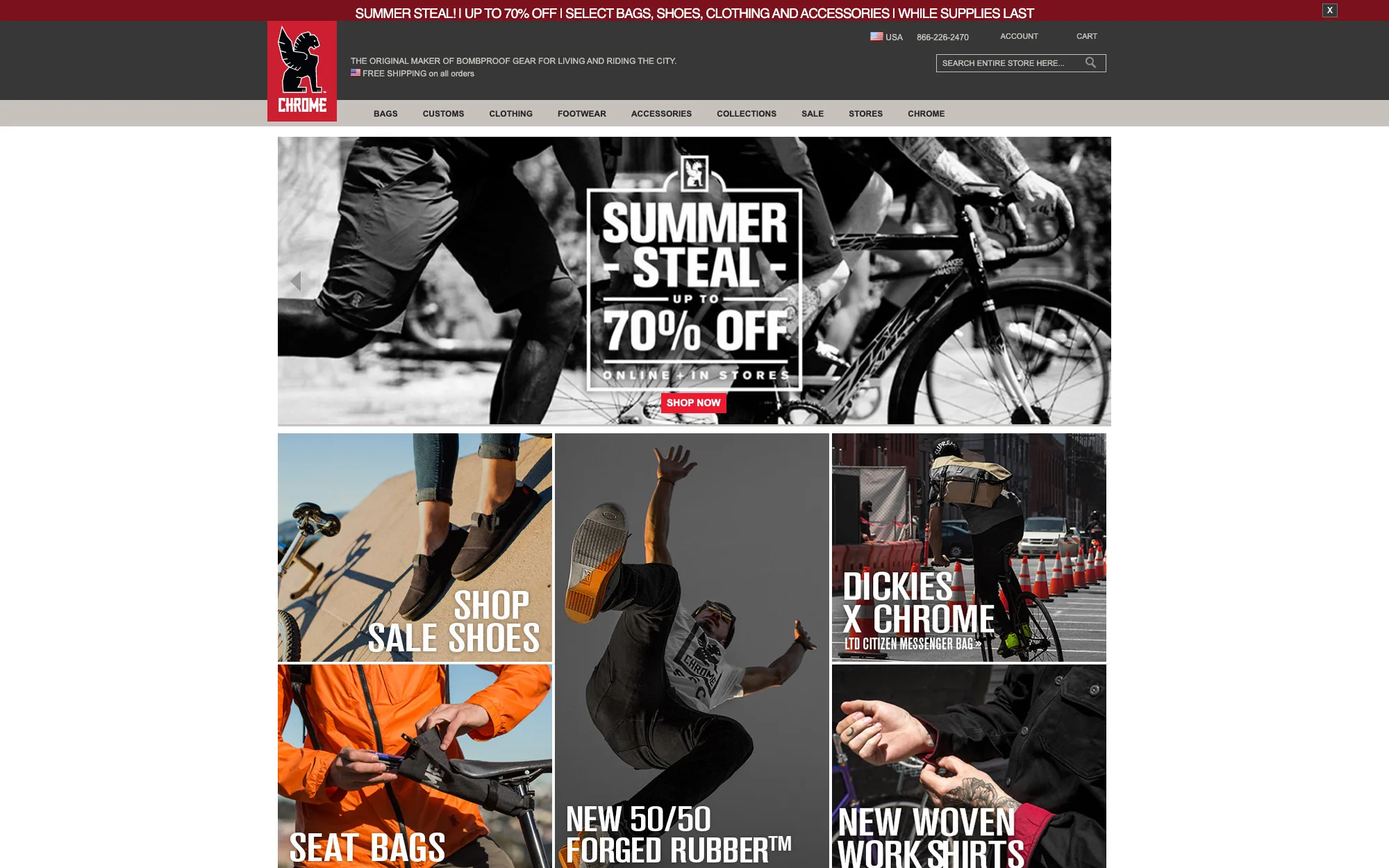
The Chrome Industries homepage in June 2015: a red banner announcing “Summer Steal — up to 70% off”, a hero of a cyclist and bike, and a grid of product tiles — Shop Sale Shoes, Dickies x Chrome, Seat Bags, New 50/50 Forged Rubber, New Woven Work Shirts — under the Chrome knight logo.

The Magento storefront I built custom product, category and landing page layouts for. 2014 was the year mobile stopped being optional; the responsive rebuild took a quarter off the bounce rate.

Archived Wayback · 2015

Discovery

A genuinely devoted customer base raises the stakes on the product page — these buyers know the seatbelt buckle by name and will notice if a spec is wrong. The other finding was in the analytics rather than the brief: 2014 was the year mobile stopped being optional, and bounce on small screens was the largest single number on the table.

Design

Custom product detail, category, and landing page layouts built around the specification detail those buyers came for, and a responsive rebuild across the store.

Development

The Magento template work behind those layouts, plus custom JavaScript and CSS written specifically to get page weight down rather than to add anything.

Security & compliance

I led the PCI self-assessment questionnaire and scan through to full compliance — unglamorous, non-negotiable, and the kind of work that only becomes visible when it has not been done.

Outcomes

  • Add-to-cart up 20% and retention up 40% from the custom PDP, category, and landing page layouts
  • 30% faster page loads from custom JavaScript and CSS
  • 25% lower bounce from the responsive build
  • PCI SAQ and scan led through to full compliance
Role
Magento Developer
Engagement
2014 – 2015
Discipline
Ecommerce · Development · Design · Security
MagentoResponsiveJavaScriptCSSPCI compliance
12

Thismoment

Software & Production Engineer · 2013 – 2014

Branded content hubs and user-generated content platforms for Fortune 500 marketers — Coca-Cola, Procter & Gamble, Frito-Lay, AT&T.

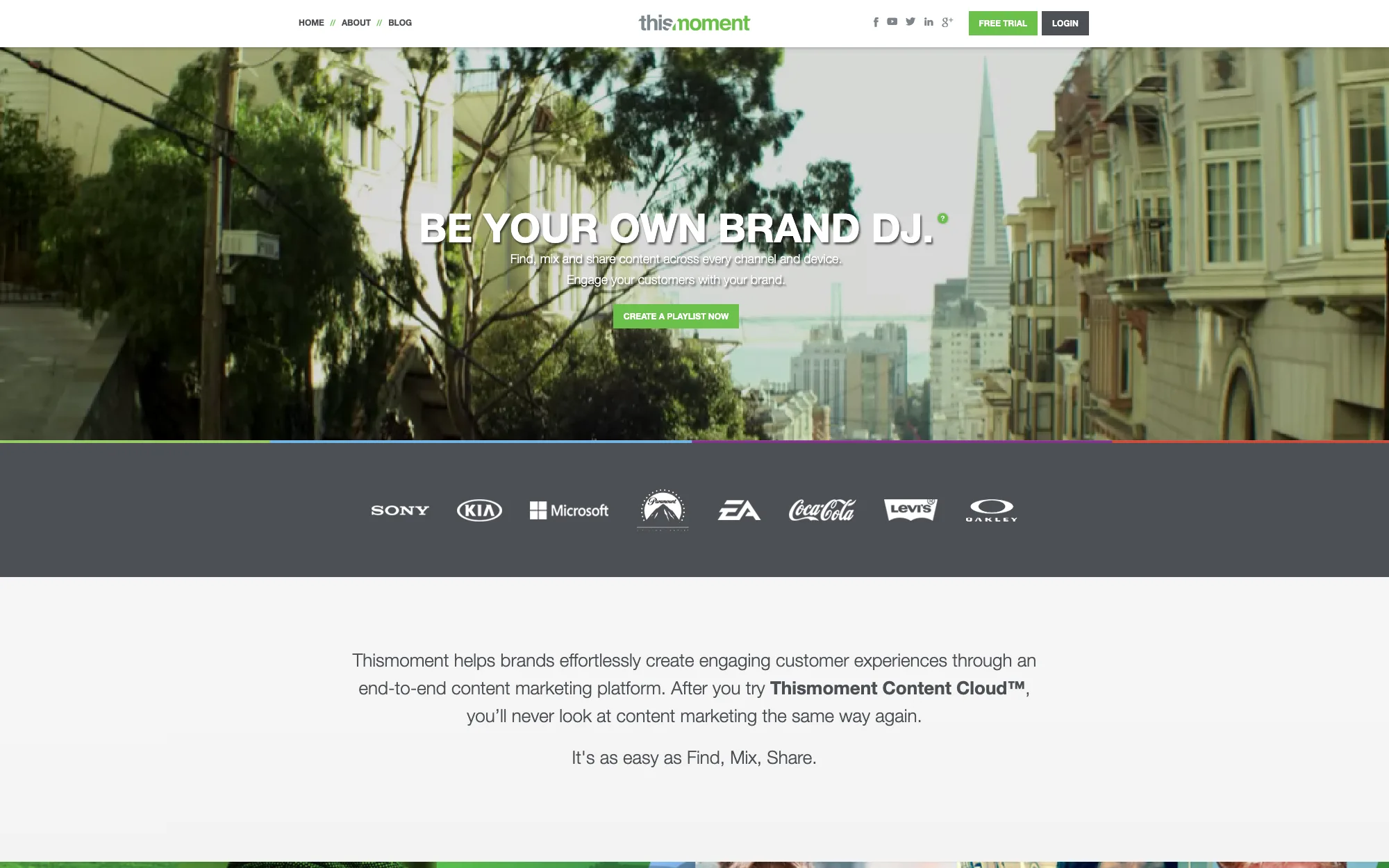
The Thismoment homepage in March 2014: a San Francisco street scene with the Transamerica Pyramid in the distance, headlined “Be your own brand DJ.”, above a grey band of client logos — Sony, Kia, Microsoft, Paramount, EA, Coca-Cola, Levi’s, Oakley.

The platform company whose UGC tooling and video player I worked on. That logo row is the reason buffering mattered so much: a campaign launch for any one of them looked indistinguishable from an attack.

Archived Wayback · 2014

Discovery

Campaign platforms have an unusual failure profile: a successful launch is indistinguishable from a denial-of-service attack. Scoping every build started with the ceiling rather than the feature list — what happens on the day the campaign works.

Architecture

Collection, moderation, and playback designed to hold at campaign scale, with the moderation queue sitting between the public feed and the page so a brand hub could never publish something nobody had looked at.

Development

The custom UGC platforms and the video tooling underneath them. The rebuild I remember is the video player: buffering is the metric nobody puts in the brief and everybody notices, and halving it did more for engagement than any feature shipped that quarter.

Integrations & APIs

Social and content platform APIs feeding the hubs, normalized so one moderation pipeline served every source.

Outcomes

  • Custom UGC platforms and video tooling shipped for Fortune 500 brands
  • Video player rebuild cutting buffering 50%
Role
Software & Production Engineer
Engagement
2013 – 2014
Discipline
Development · Integration · CMS
JavaScriptVideoUGC platformsAPIs
13

Prima Studio

Ecommerce Architect & Lead Developer · Dec 2011 – Sep 2013

A Magento storefront for a dancewear label, with video carrying the product.

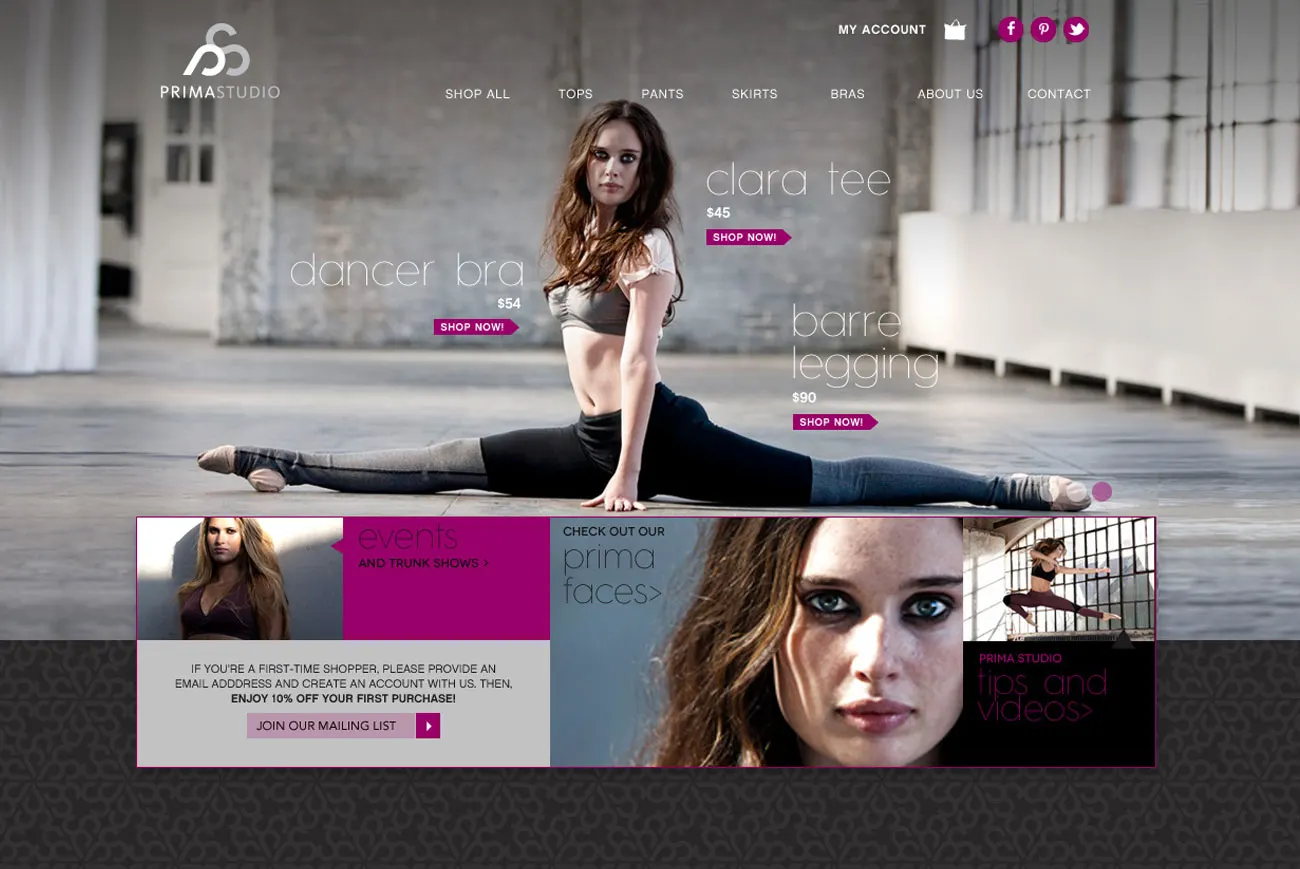
The Prima Studio storefront: a dancer in the splits on a studio floor under a magenta-and-grey layout, with hotspot labels for “dancer bra $54”, “clara tee $45” and “barre legging $90”, above panels for events and trunk shows, Prima Faces, and tips and videos.

Dancewear ecommerce on Magento, front and back end. Note the shoppable hotspots and the video panels — both custom, and both reasons the stock platform had to get 70% faster before any of it was usable.

Own archive Domain since reassigned

Discovery

Stock Magento in 2012 was slow, and the industry consensus was that this was simply the price of Magento. Benchmarking said otherwise. The entire engagement was built on that finding, which is the only reason the number at the end is what it is.

Architecture

Front and back end rebuilt around performance as a constraint rather than tuned for it afterwards — the two produce very different systems and only one of them holds.

Design

Storefront and product presentation designed around motion, because in a dancewear catalogue a still photograph of a garment is missing the thing being sold.

Development

The Magento build front and back, plus a custom HTML5 video player. That component dates the project precisely: Flash was dying but not yet dead, and building native video in 2012 meant handling every browser’s idea of a codec yourself.

Integrations & APIs

Analytics and conversion instrumentation across the full funnel, so the optimization work had numbers behind it rather than instinct.

Outcomes

  • 70% performance gain over stock Magento
  • Custom HTML5 video player, built ahead of broad browser consensus
  • Analytics and conversion instrumentation across the full funnel
Role
Ecommerce Architect & Lead Developer
Engagement
Dec 2011 – Sep 2013
Discipline
Ecommerce · Architecture · Design · Development
MagentoHTML5 videoAnalyticsPerformance
14

Urban Air Market

Architect, Developer & Creative Director · 2011 – 2013

The site for a sustainable design marketplace running pop-up events for independent designers across the Bay Area.

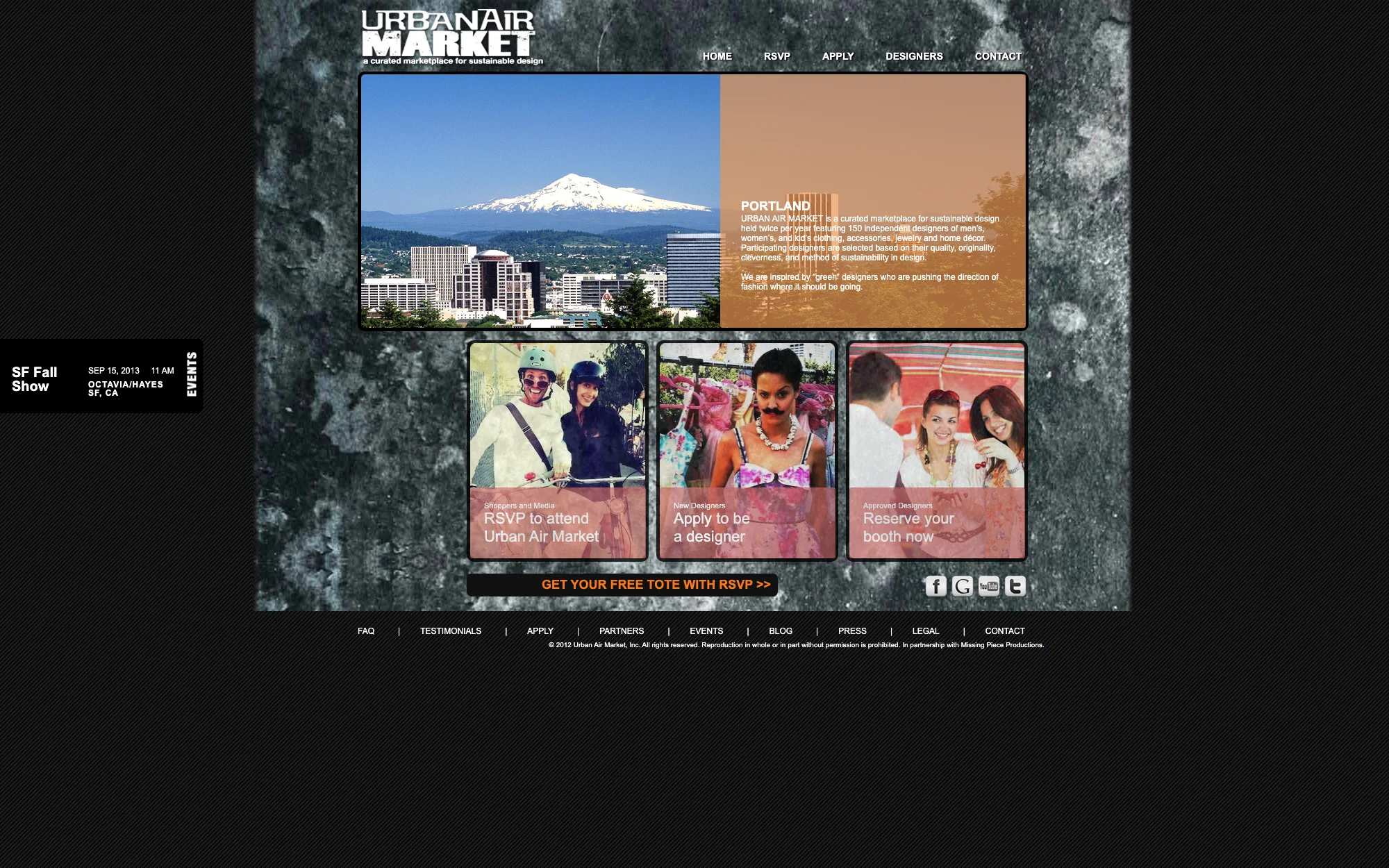
The Urban Air Market homepage in June 2013: a concrete-texture background with a photograph of Mount Hood above the Portland skyline, a Portland event description, and three tiles reading “RSVP to attend Urban Air Market”, “Apply to be a designer” and “Reserve your booth now”, above a green call to action.

Identity, print, email and CMS, all mine. Three tiles for three completely different audiences — shoppers, designers and vendors — which is the whole information architecture problem of a marketplace in one screen.

Archived Wayback · 2013

Discovery

The brand had to hold up in three places at once: a website, printed collateral handed out at the events themselves, and the email program that filled them. Three media that punish a logo in three different ways, and the mark had to be resolved against all of them before anything got built.

Design

I directed the creative — full identity across site, print, and email, including the event collateral.

Architecture & development

Then I built it: the site, the CMS front and back end, and the SEO program. Being on the hook for the build is a useful constraint on the art direction — you stop specifying things you know you will resent implementing.

Outcomes

  • Full identity across site, print, and email
  • CMS front and back end, built to be run by the event team
  • SEO program, and an 80% performance gain over standard builds of the period
Role
Architect, Developer & Creative Director
Engagement
2011 – 2013
Discipline
Design · Architecture · CMS · Development
CMSIdentityPrintEmailSEO
15

Euro RSCG

Lead Developer · 2011

A branded game for a global advertising network, plus its companion iOS and Android apps.

Four screens from Flu Fighter, the HTML5 flu-symptom quiz game, pinned to a blurred blue board: the title screen with a feverish hand-drawn boy and a Play Game button, a timed question asking which is a common symptom of the flu, a “Good Job!” explanation panel, and a results screen reading “8/16 Correct!”.

Flu Fighter, after the port: title, a timed question, the feedback panel, the score. The agency’s own site was Flash and never archived in a form a browser can open — a tidy irony, given the brief was getting this game off Flash because phones had stopped playing it. These screens are my own.

Own archive HTML5 port · 2011

Discovery

The brief was a Flash-based game that needed to run on phones, which in 2011 meant it needed to stop being Flash. Apple had published Thoughts on Flash about a year earlier and most agencies were still arguing about it; here the client’s own analytics had already settled the argument, so the discovery work was mostly showing people the numbers.

Development

Ported the game to HTML5 and jQuery Mobile, halving load times in the process, then built the companion iOS and Android applications on top of the same game logic.

Outcomes

  • Flash game ported to HTML5 and jQuery Mobile, halving load times
  • Companion iOS and Android applications shipped
Role
Lead Developer
Engagement
2011
Discipline
Development · Design
HTML5jQuery MobileiOSAndroid
16

Moss Outdoor

Lead Developer · 2010 – 2011

An outdoor furniture catalogue and online store.

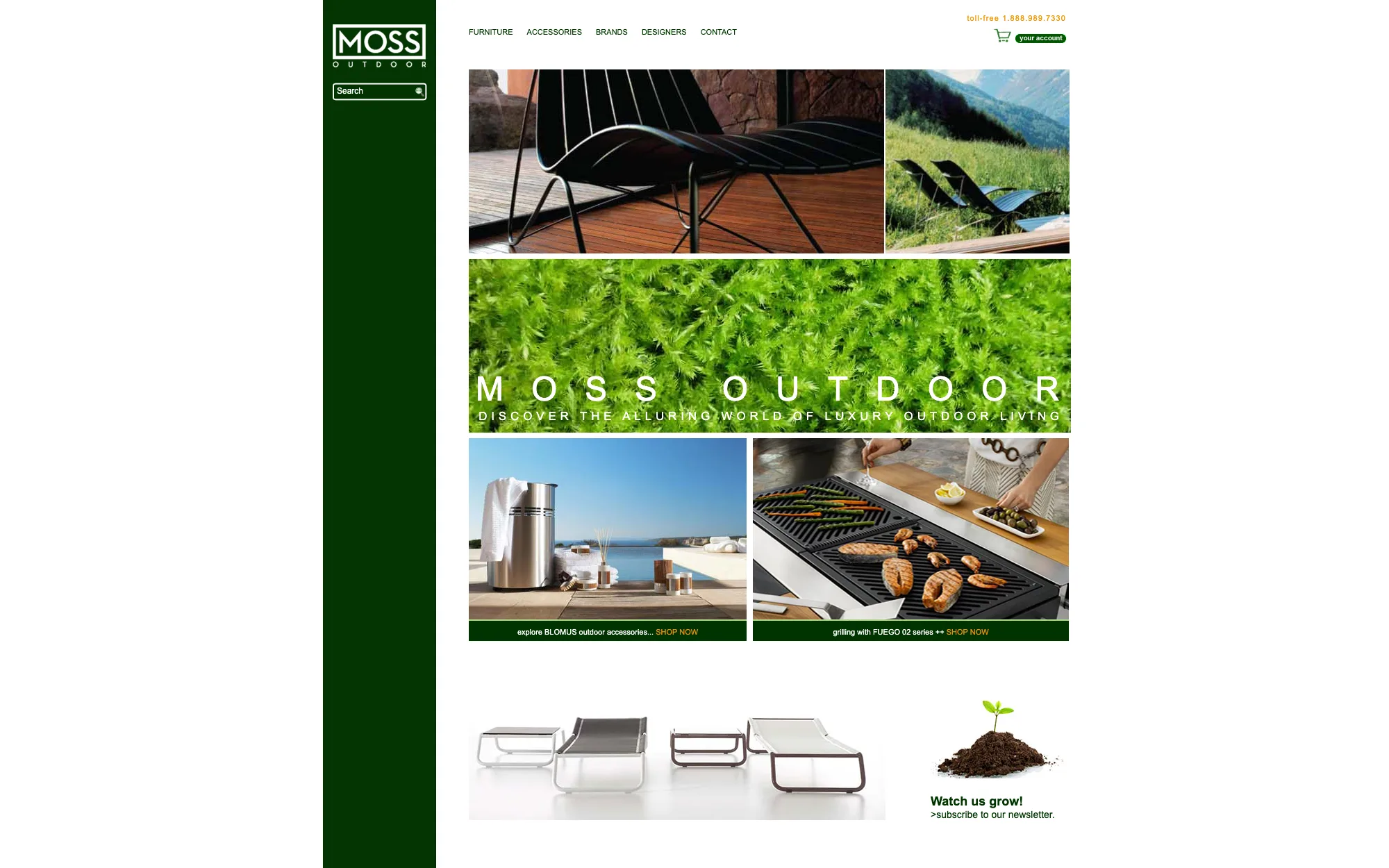
The Moss Outdoor homepage in February 2011: a dark green sidebar carrying the Moss logo and search, beside a grid of outdoor-living photography — a black lounge chair on a deck, loungers on a hillside, a moss-covered banner reading “Discover the alluring world of luxury outdoor living”, and a grill — with a “Watch us grow!” newsletter panel below.

UI design through CMS build and commerce integration. The 220% visibility lift came from making this catalogue legible to search engines at all — most of the win was structural, not clever.

Archived Wayback · 2011

Discovery

A catalogue where the photography carries the sale and the specification table closes it — and, underneath that, product content the search engines could not reach at all. The structural finding was worth more than anything on the feature list.

Design

UI design across the catalogue, category, and product pages, built around large photography without letting it push the specifications off the screen.

Development

Production CMS build against that design, plus the commerce integration behind it.

SEO

The 220% visibility lift is the number that still surprises people, and it is only possible on a site that started with a structural problem. Most of the win was making the catalogue legible to crawlers rather than anything clever.

Outcomes

  • UI design through production CMS build
  • Commerce integration
  • SEO program lifting search visibility 220%
Role
Lead Developer
Engagement
2010 – 2011
Discipline
Design · CMS · Ecommerce · Development
CMSCommerceUI designSEO
17

Madison Equities

Flash Designer & Developer · 2009

The corporate site for a Manhattan real estate developer, built in Flash.

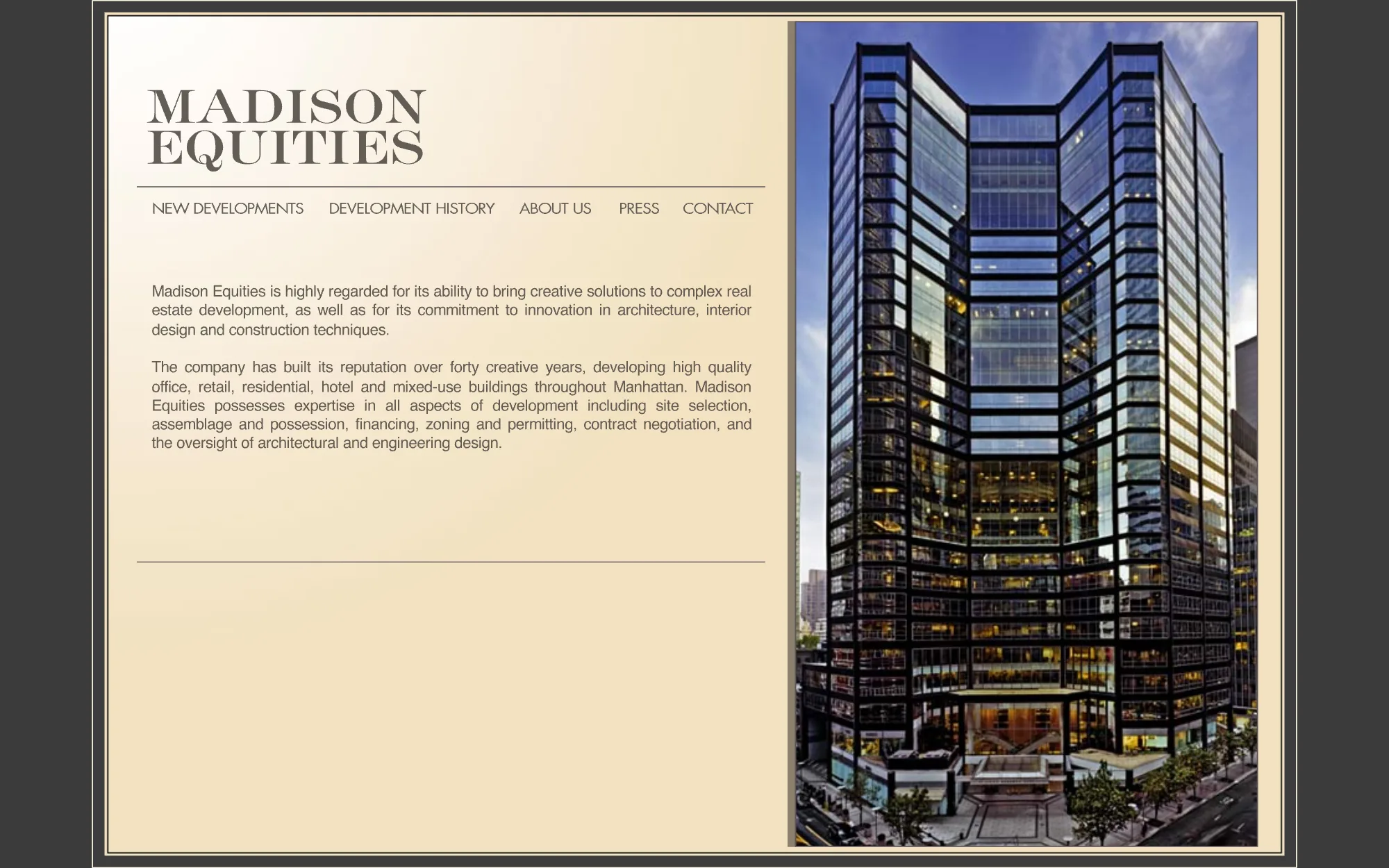
Design through build, in Flash, with deep linking so every section had its own address. What’s playing is the original 2009 file. Go ahead and click around.

Own archive Original SWF · 2009

Discovery

A developer with forty years of Manhattan buildings behind it and nowhere to show them. The site had two jobs: sell new developments that mostly existed as renderings, and make the back catalogue, from the Excelsior in 1965 to the W Times Square, read as one body of work.

Design

A set of competing concepts — Classic, Clean Lines, Color Impact — before one comp was approved. The client’s March notes asked for restraint: the cube-wipe transitions became fades, the type came down a point, and Development History became a timeline, each building placed on it by decade.

Development

Flash 8 and ActionScript 2, with Tweener for the motion. Deep linking ran through SWFAddress, so every section had its own URL, the back button worked, and Google Analytics could count pages — none of which Flash did on its own. The stage scales to the window, with bitmap smoothing so the architectural photography held up at any size.

Outcomes

  • Launched April 2009
  • Deep-linked, analytics-tracked Flash site
  • Development history built as an interactive timeline
  • Still running today from the original SWF
Role
Flash Designer & Developer
Engagement
2009
Discipline
Design · Development
FlashActionScript 2SWFAddressUI designAnalytics
18

Nimblefish Technologies

Lead Web Developer · 2002 – 2008

Marketing automation and variable-data campaigns — personalized web and print at volume for enterprise clients.

The Nimblefish Technologies homepage in June 2005: a small fixed-width layout with the nimblefish fish logo and the tagline “get relevant. get results.”, a Solutions / Technology / Company menu, a client strip showing Inktomi, Sony and HP, and a red panel reading “the average customer is a myth”.

Six years building against their proprietary CMS on Linux, Apache and Tomcat. The capture is enlarged — the page is a fixed-width 2005 layout and occupies about a third of a modern window.

Archived Wayback · 2005

Discovery

Every campaign started as a data question rather than a design one: what fields exist per recipient, which of them can be trusted, and what the page does when one is missing. Personalization at volume fails on the empty field, not the full one.

Architecture

Everything was built against a proprietary CMS on Linux, Apache, and Tomcat. Six years working inside somebody else’s CMS teaches you the thing no framework tutorial does: what a platform’s assumptions cost you three years later, and how to design so the answer is “less than it could have been.”

Development

Web and email builds in JSP against that CMS, personalized per recipient at campaign volume — years before “marketing automation” was a category with a Gartner quadrant.

Outcomes

  • Six years of web and email builds against a proprietary CMS
  • Linux / Apache / Tomcat production environment
  • Variable-data personalization across web and print at enterprise volume
Role
Lead Web Developer
Engagement
2002 – 2008
Discipline
Development · CMS · Integration
Proprietary CMSLinuxApacheTomcatJSPEmail
19

Nationalflashback

Consultant & Creative Director · 2000 – 2008

My first independent practice — a design and development shop serving enterprise, small-business, and agency clients.

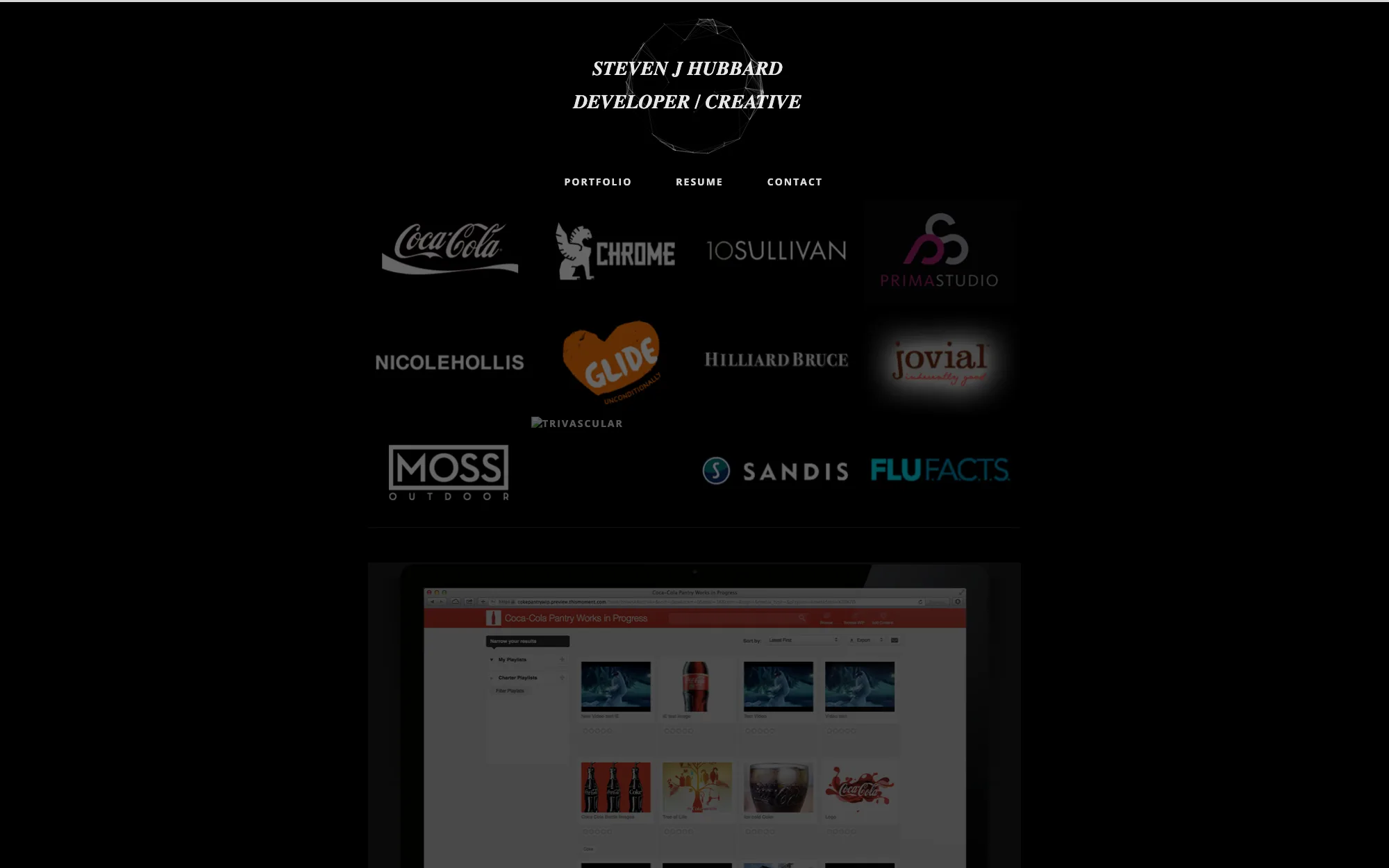
The nationalflashback.com portfolio in August 2019: a black page headed “Steven J Hubbard, Developer / Creative” inside a wireframe circle, a Portfolio / Resume / Contact menu, a client logo wall including Coca-Cola, Chrome, 1OSullivan, Prima Studio, Nicole Hollis, Glide, Hilliard Bruce, Jovial, Moss Outdoor, Sandis and FluFacts, and a laptop showing the Coca-Cola Pantry case study.

The practice’s Flash site from 2000–2008 no longer renders. This is the portfolio that later replaced it on the same domain, captured August 2019.

Archived Wayback · 2019

Discovery

Eight years of running my own shop meant every engagement started with me in the room for the sales conversation, the requirements, and the estimate. That is where the habit of assessing current state before proposing anything came from — when you own the estimate, an optimistic assumption is expensive and personal.

Architecture & design

Architecture, build, and creative direction were not separate offerings so much as the same job seen from different ends. A small practice does not get to specialize, which turns out to be the most useful training available.

Development

Front-end and CMS builds across the client roster, delivered solo or with contractors I directed. Nearly everything from this period is gone from the live web; the capture beside this is the later portfolio that carried the domain forward.

Outcomes

  • Independent practice sustained eight years across enterprise, SMB, and agency clients
  • Architecture, build, and creative direction owned end to end on every engagement
Role
Consultant & Creative Director
Engagement
2000 – 2008
Discipline
Design · Development · Architecture · CMS
Creative directionArchitectureFront endCMS
20

Puzzle Theory

Art Director & Lead Developer · 2002 – 2005

A design studio — site strategy, cross-platform build, and printed collateral for its clients.

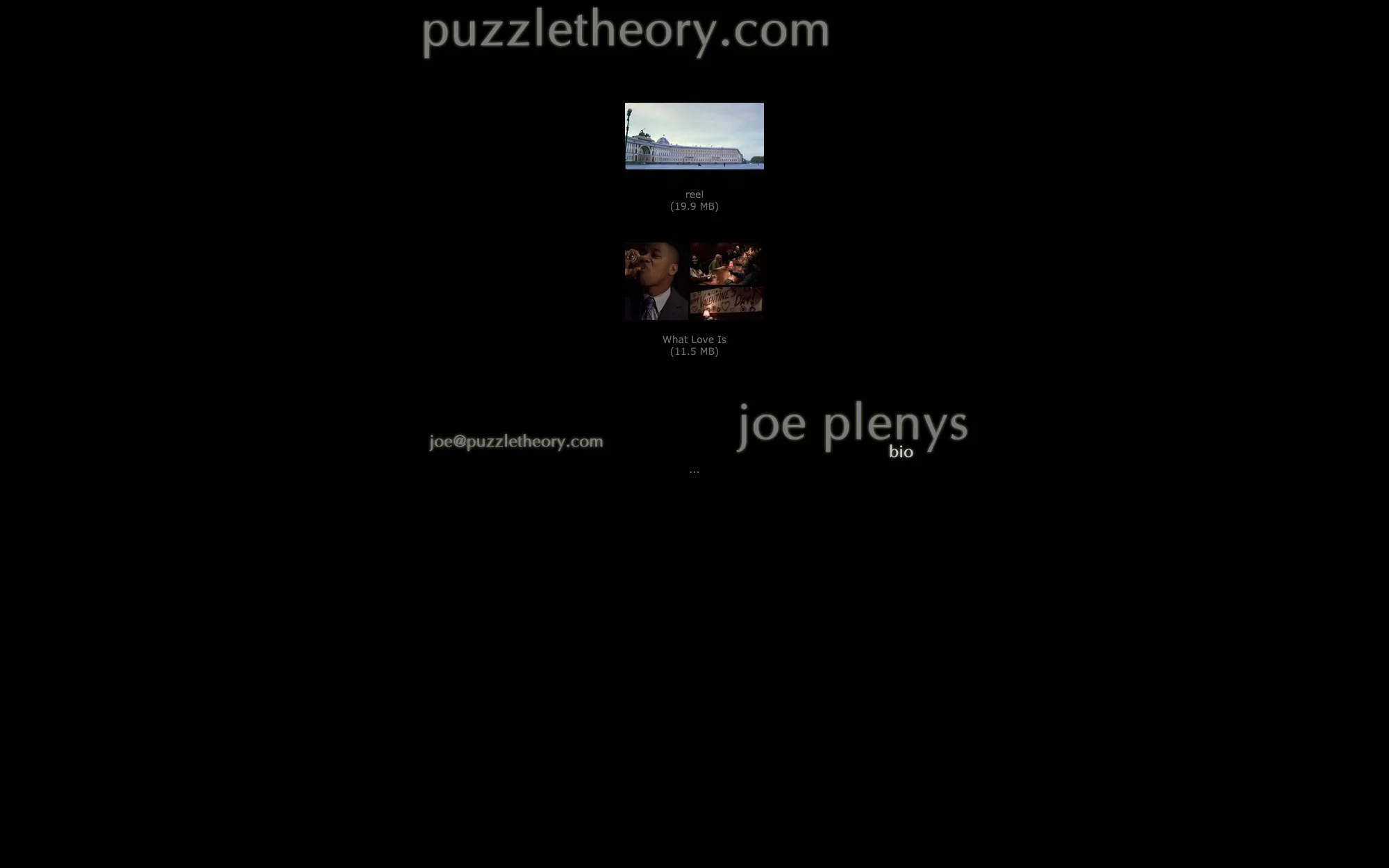
The puzzletheory.com homepage: an almost entirely black page with the domain set large in grey at the top, two small video thumbnails labelled “reel” and “What Love Is” with their file sizes, and a contact address beside the name “joe plenys”.

The earliest surviving capture is from 2011 — six years after the engagement ended. Nothing from 2002–2005 was ever archived, so this is the nearest evidence that exists rather than the site as I built it.

Archived Wayback · capture

Discovery

Site strategy and information architecture, done as the first phase of every project rather than as a deliverable sold separately. The earliest work in this archive and the point where the sequence — strategy, then structure, then surface — became habit.

Design

Art direction across screen and print on the same projects, so the collateral and the site were one thing rather than two interpretations of a brand.

Development

Cross-platform build, which in 2003 meant Netscape as well as Internet Explorer. A reasonable illustration of how much the job has changed: the layout problems of that period were solved with tables and spacer GIFs because there was nothing else.

Outcomes

  • Site strategy and information architecture
  • Cross-platform build across the browser matrix of the period
  • Collateral production alongside the digital work
Role
Art Director & Lead Developer
Engagement
2002 – 2005
Discipline
Design · Development
Art directionFront endPrint
21

OdySay

Architect & Magento Developer · Contract

A Magento storefront for a fashion label.

The OdySay storefront: a soft-focus photograph of a woman in a pale green halter gown standing in tall grass, with a white sidebar carrying the ODYSAY wordmark and a Collection, Shop, About, Contact menu, and a black newsletter panel in the upper right.

A fashion label on Magento. The full-bleed lookbook photography is the reason the catalog architecture had to be planned for growth — a store this image-heavy gets slow first and unmaintainable second.

Own archive Domain since reassigned

Discovery

The useful question was not what the store needed on launch day but what it would need after growth — how the catalogue would be cut two seasons later, and which of today’s conveniences would be load-bearing by then.

Architecture

Catalog structure and checkout flow designed for that later business rather than the current one. It is the difference between a store that scales and one that gets rebuilt in eighteen months by someone cursing your name.

Development

The Magento build against that architecture, front and back.

Integrations & APIs

Integration work tying the storefront to the systems behind it, each designed as a reusable pattern, so inventory, orders, and product data stayed consistent without anyone reconciling spreadsheets on a Friday afternoon.

Outcomes

  • Catalog and checkout architecture built with growth headroom
  • Third-party integrations designed as reusable patterns
Role
Architect & Magento Developer
Engagement
Contract
Discipline
Architecture · Ecommerce · Development
MagentoArchitectureIntegrations
22

Terra Firma Music

Architect, Designer & Developer · Contract

A music site — artwork, audio, and video for an artist roster.

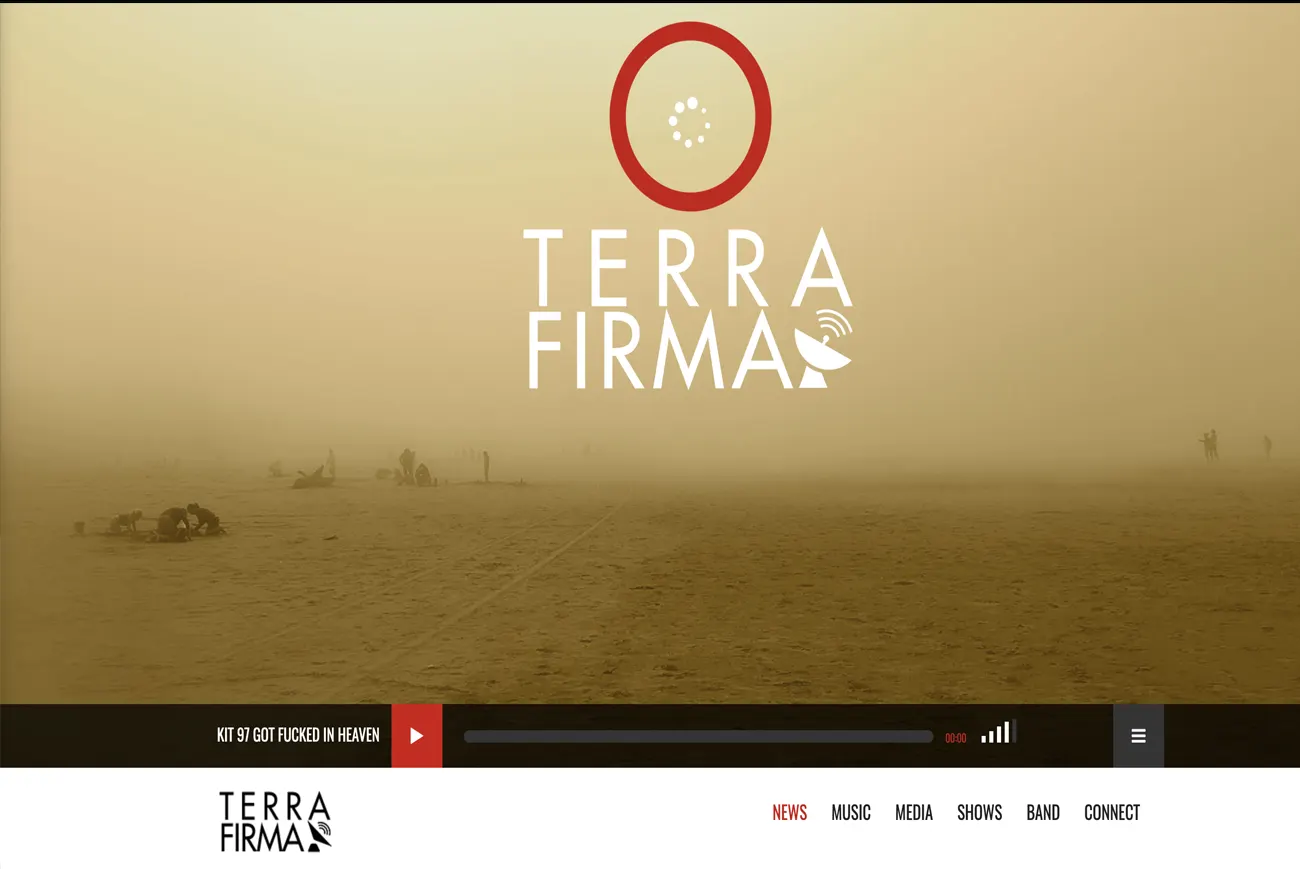
The Terra Firma Music homepage: a dusty golden desert scene, figures barely visible through haze, with the Terra Firma logo and satellite-dish mark centred over it. A persistent audio player runs along the bottom with a track cued up, above a navigation bar reading News, Music, Media, Shows, Band, Connect.

Identity through build. The persistent player at the foot of the page is the whole performance problem in one component — it has to survive navigation without re-buffering, on a page already carrying full-bleed imagery.

Own archive No Wayback capture survives

Discovery

Music sites are media-heavy by nature, and the usual outcome is a beautiful page that takes eight seconds to become useful, by which point the visitor has gone back to the streaming service. That constraint was established before the design started rather than discovered after launch, which is why it was survivable.

Design

Identity and visual design end to end, built to carry artwork at scale without the page becoming a gallery the visitor has to wait for.

Architecture & development

The front end was tuned around first render from the outset rather than optimized after the fact — the only version of performance work that actually holds. A CMS behind it so the roster could be updated without me.

Outcomes

  • Full identity through production build
  • Media-heavy pages tuned for fast first render
  • CMS handover for independent roster updates
Role
Architect, Designer & Developer
Engagement
Contract
Discipline
Architecture · Design · Development · CMS
DesignFront endCMSPerformance
23

The Liquor Store SF

Architect, Designer & Developer · Contract

A San Francisco hospitality brand’s site — menus, booking, and a small storefront.

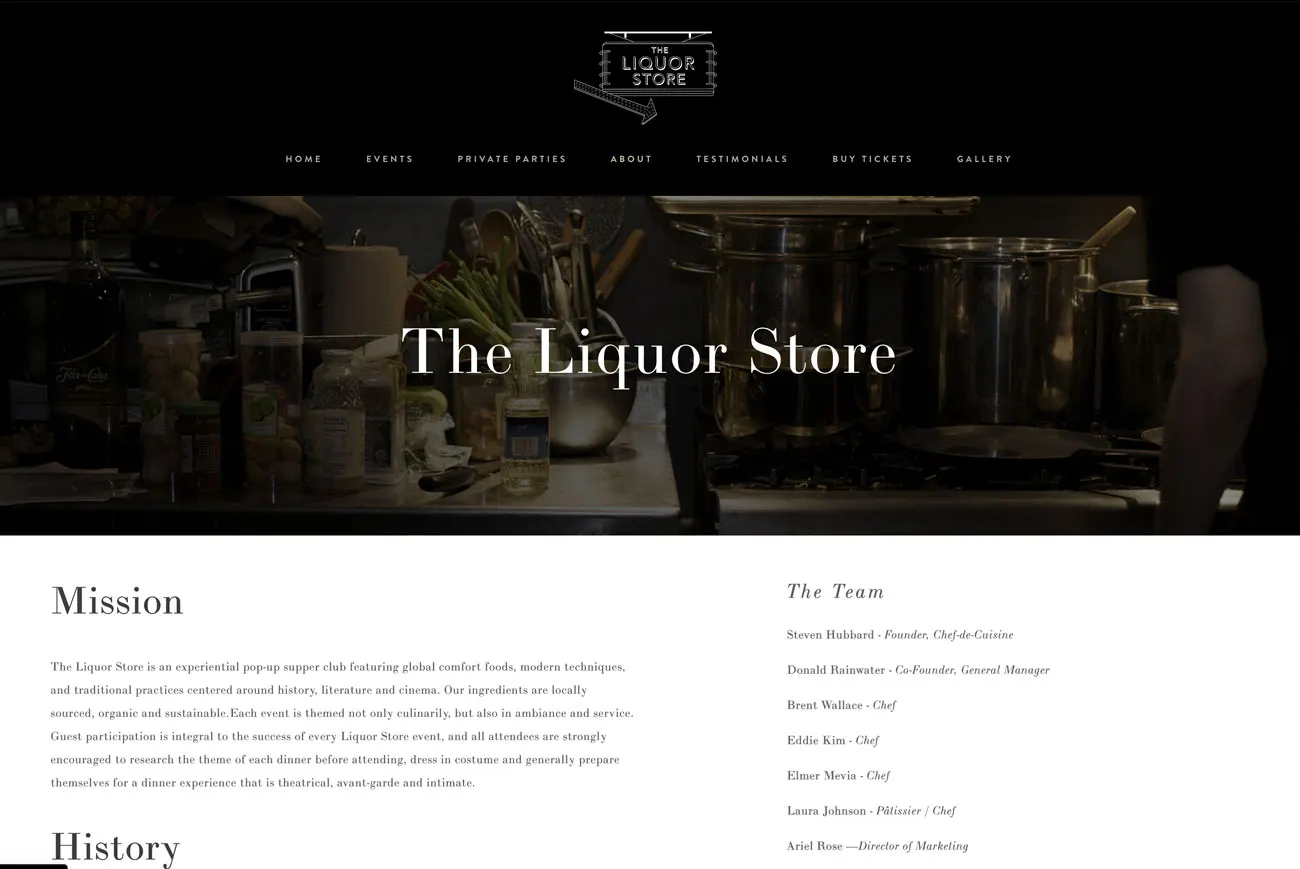
The Liquor Store SF homepage: a dark, low-lit kitchen photograph — stockpots, jars and utensils on a counter — under the title “The Liquor Store” in a light serif, above a Mission statement describing an experiential pop-up supper club and a team list headed by Steven Hubbard, Founder and Chef de Cuisine.

Architecture, design and build. The photography is deliberately dark because the room is — a menu that only reads well in daylight is a menu nobody at the bar can use.

Own archive No Wayback capture survives

Discovery

Hospitality has a context problem that most responsive briefs quietly skip: the person reading your menu is holding a drink, the room is dark, and they have about fifteen seconds of patience. Everything downstream was scoped against that situation rather than against a desktop comp.

Design

Booking and menu flows designed mobile-first for that context and desktop second. Design, architecture, and build were all mine, which meant the responsive behaviour was a design decision made up front rather than a development compromise negotiated at the end.

Development

WordPress build with the storefront integrated into the brand site, so ordering and reservations did not hand the visitor off to somebody else’s checkout mid-decision.

Outcomes

  • Mobile-first booking and menu flows
  • Storefront integrated with the brand site
Role
Architect, Designer & Developer
Engagement
Contract
Discipline
Architecture · Design · Development · Ecommerce
DesignWordPressCommerceMobile-first
24

First Presbyterian Church

Architect & WordPress Developer · Contract

A congregation’s WordPress site — services, events, and giving.

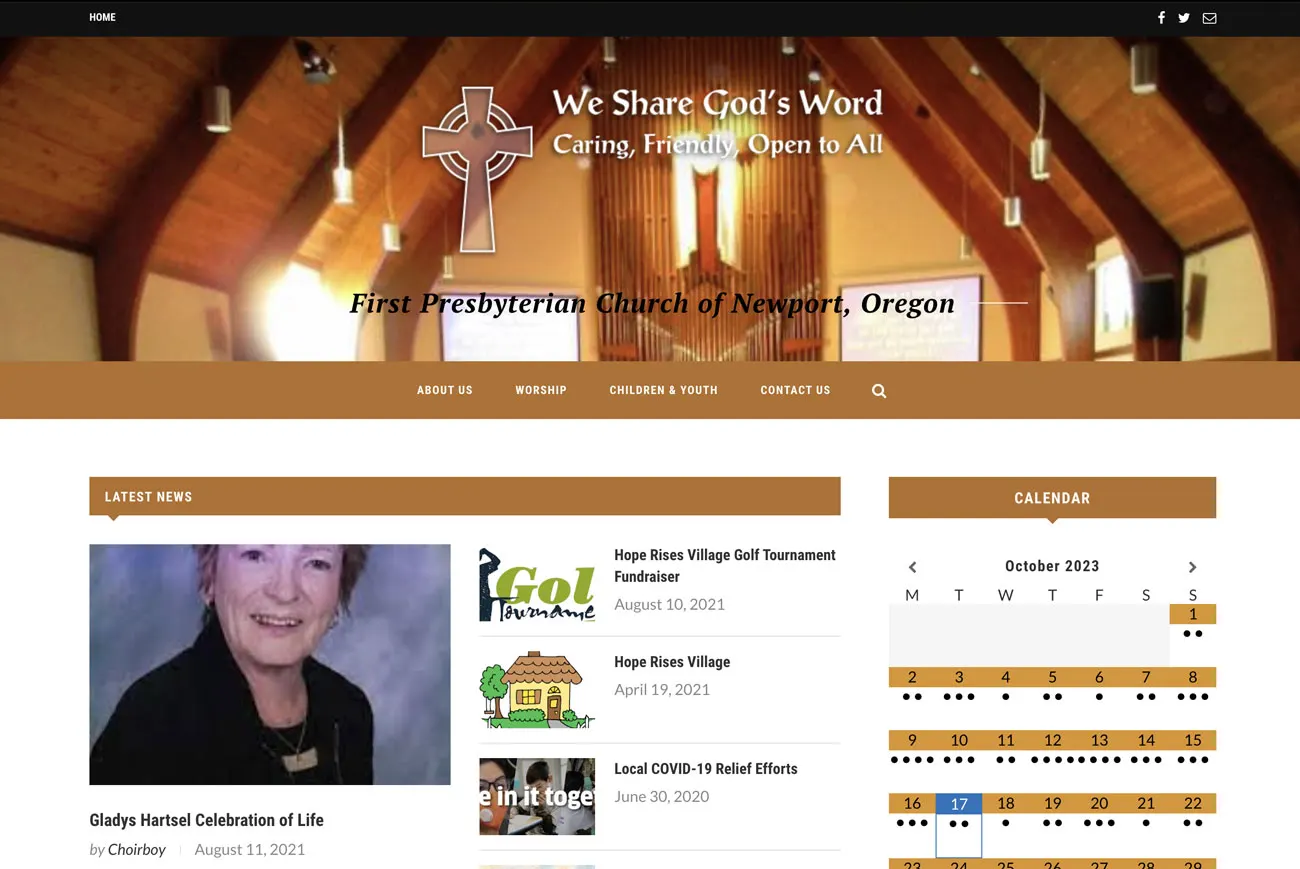
The First Presbyterian Church of Newport, Oregon homepage: a photograph of the sanctuary’s wooden ceiling and organ pipes behind a cross and the words “We Share God’s Word — Caring, Friendly, Open to All”, above a Latest News column and a month calendar widget marked with event dots.

Restructured for volunteers. The calendar is the reason: it is the one thing on the site that has to be edited every week by somebody who does not want to learn WordPress.

Own archive No Wayback capture survives

Discovery

One constraint shaped every decision here: the people maintaining this site after I left are volunteers, not developers. That rules out most of the interesting answers, and it is a genuinely better brief than it sounds — it forces you to justify complexity to somebody who will never read the documentation.

Architecture

Restructured around what a volunteer can safely edit. Anything clever enough to need me later was the wrong answer, so the clever parts were removed rather than documented.

Development

An accessibility pass across templates and content, and security hardening on a WordPress install that had accumulated the usual decade of plugin debt.

Outcomes

  • Restructured for volunteer maintenance
  • Accessibility pass and security hardening
Role
Architect & WordPress Developer
Engagement
Contract
Discipline
Architecture · CMS · Security
WordPressAccessibilityHardening